

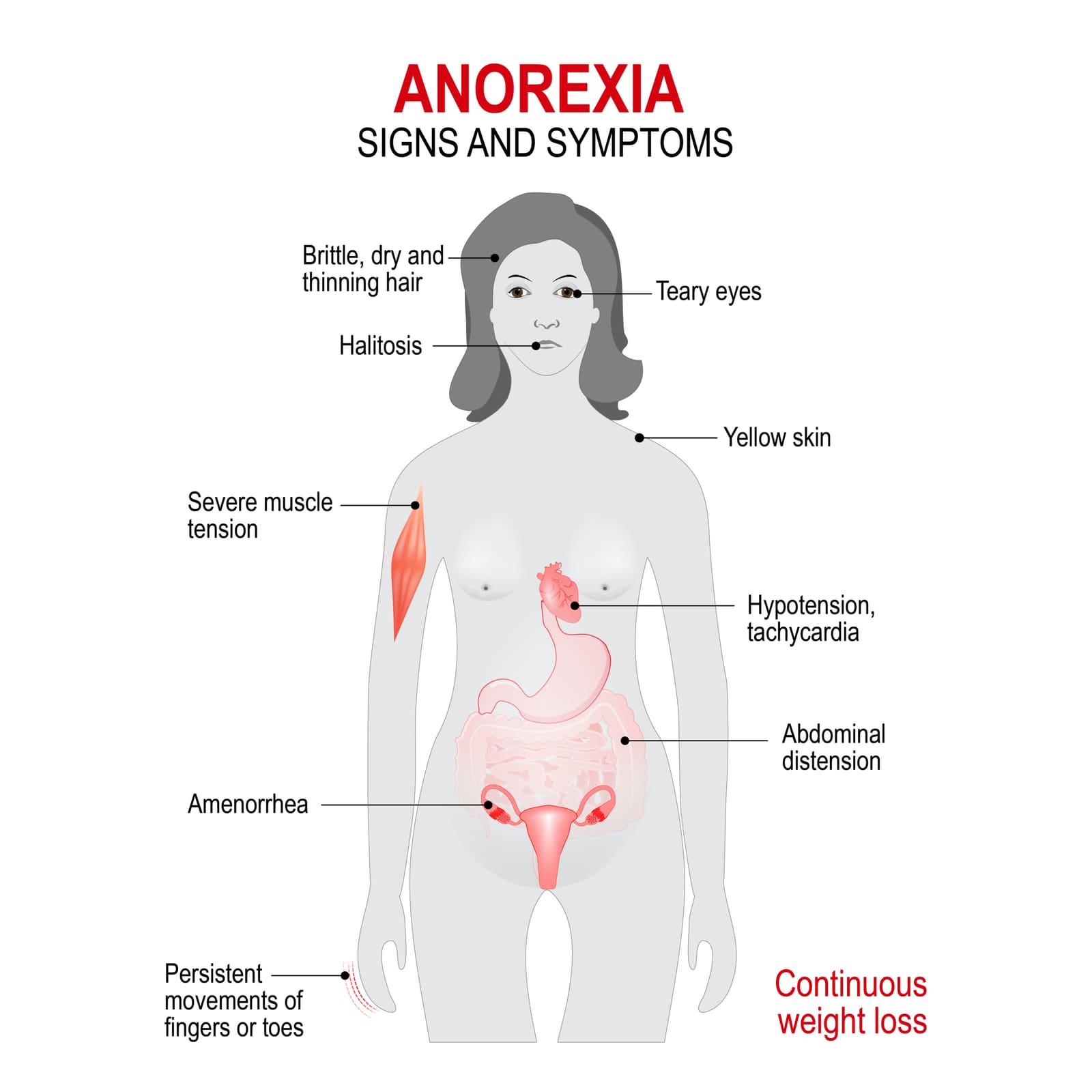
An eating disorder is an illness where you experience serious disturbances in your behaviors of eating and related emotions and thoughts. Individuals with eating disorders usually become preoccupied with their body weight and food. Nearly 9% of the worldwide population has an eating disorder, and 9% (28.8 million) of individuals in the U.S. will struggle with an eating disorder in their lifetime.
Types of Eating Disorders
Eating disorders are grouped into the classification of related conditions that cause severe physical and emotional issues. Extreme weight and food issues are typically involved in each condition, but each has its own set of symptoms that separate it from the other conditions.
Anorexia Nervosa
With anorexia, you won't allow yourself food to where you're starving yourself because you are obsessed with weight loss. With anorexia, you will:
- Refuse to eat
- Deny hunger
- Binge eat
- Purge
- Exercise
You'll do these things to the point of exhaustion as you're attempting to eliminate, limit or "burn" calories.
You'll experience emotions of anorexia, including:
- Social withdrawal
- Irritability
- Not understanding the seriousness of your situation
- Lack of emotion or mood
- Obsession with exercise or food
- Fear of eating in public
You'll often develop food rituals or eliminate whole categories of food from your diet because you fear it will cause you to become fat.
Potential Health Effects of Anorexia
Anorexia takes a huge physical toll. Inadequate nutrition and very low food intake cause you to become extremely thin. Your body is then forced to slow down to help it conserve its energy which causes problems like:
- Loss of menstruation
- Irregularities
- Abdominal pain and constipation
- Low blood pressure
- Irregular heart rhythms
- Trouble sleeping
- Dehydration
With anorexia, you might also practice binge and purge behaviors or you might simply restrict eating altogether.
Bulimia Nervosa
With bulimia, you often feel out of control when you binge on extremely big amounts of food during brief time periods and then will desperately try to get rid of the extra calories by:
- Abusing laxatives
- Forced vomiting
- Excessive exercise
This turns into a vicious, repeated cycle that controls a lot of aspects of your life and has an extremely negative effect both physically and emotionally. Despite having bulimia, your weight is typically normal or you might even be a bit overweight.
You might experience low self-esteem which is overly associated with your body image, you might feel guilty or feel like you're out of control or shameful about eating and you withdraw from your family and friends.
Potential Health Effects of Bulimia Nervosa
Just like with anorexia, bulimia can cause physical damage. Constantly binging on food and purging it can:
- Seriously harm your body parts involved in the consumption and digestion of food
- Cause damage to your teeth through the frequent acid reflux and vomiting
- Cause dehydration that will affect the electrolytes in your body and lead to heart failure, cardiac arrhythmias, and even death
Binge Eating Disorder (BED)
With BED, you lose control over your eating and eat a big amount of food in a brief time period. You might also consume a lot of food even when you're not hungry or after you're uncomfortably full. This can cause you to feel:
- Disgusted
- Embarrassed
- Guilty
- Depressed
With BED, after you experience a binge eating episode, you don't attempt to exercise or purge excessively like you would with bulimia or anorexia. With BED, you might be overweight, normal weight, or obese.
Potential Health Effects of BED
You can experience a multitude of dermatologic, gastrointestinal, and endocrine effects including
- Dry skin
- Acid reflux
- Brittle hair or hair that falls out
- Bloating
- Nausea
- Abdominal cramps
- Diarrhea
- Low energy
- Sluggishness
- Sleepiness
- High blood pressure
Signs of Eating Disorders
Signs of an eating disorder can vary and depend on the type of eating disorder. You'll want to stay alert for eating beliefs and patterns that may signal unhealthy behavior. Certain red flags may point towards an eating disorder, such as:
- Excessive focus on food
- Extreme loss of weight or not gaining developmental weight as you should
- Checking the mirror often for perceived flaws
- Persistent complaining or worry about being fat
- Frequently refusing to eat or skipping meals
- Using diuretics, laxatives, or enemas after you eat when they're not necessary
- Expressing disgust, depression, or guilt about eating habits
- Repeated abnormal eating episodes where large amounts of food is consumed in one sitting
Treatment Options for Eating Disorders
Treatment for eating disorders is hardly easy. An eating disorder might create several added health problems, and could even turn out to be acutely life-threatening where hospitalization is required to force nourishment.
Frequently, it takes a multidisciplinary team of health professionals which include medical doctors, psychotherapists, and specialized nutritionists or dietitians to bring about complete recovery. Residential or outpatient therapy is often used, but in some cases, hospitalization is necessary.
A support network for eating disorders is very important for you to have others you (or your loved one) can turn to for support, guidance, and to share experiences.
Looking for Tips on Managing an Eating Disorder?
Are you coping with an eating disorder? Connect with other people on Healthread to find ways to manage an eating disorder and improve your (or your loved one's) lifestyle. You don't have to struggle with an eating disorder alone. Many people are experiencing the same situation and having a support network through Healthread can truly help.
Sources
- 1nimh.nih.gov/health/topics/eating-disorders/index.shtml
- 2psychiatry.org/patients-families/eating-disorders/what-are-eating-disorders
- 3nami.org/About-Mental-Illness/Mental-Health-Conditions/Eating-Disorders
- 4anad.org/education-and-awareness/about-eating-disorders/eating-disorders-statistics/
- 5psychologytoday.com/us/basics/eating-disorders
- 6anad.org/education-and-awareness/about-eating-disorders/eating-disorder-types-and-symptoms/
- 7emilyprogram.com/blog/physical-effects-of-binge-eating-disorder/
- 8helpguide.org/home-pages/eating-disorders.htm
- 9adaa.org/eating-disorders/types-of-eating-disorders
Información general, no consejo médico
Este artículo no puede tener en cuenta tu historial de salud ni tu tratamiento actual. Habla con un profesional sanitario cualificado antes de cambiar nada de tu cuidado.
Lee nuestro aviso médico →
En esta página
Types of Eating Disorders
Anorexia Nervosa
Potential Health Effects of Anorexia
Bulimia Nervosa
Potential Health Effects of Bulimia Nervosa
Binge Eating Disorder (BED)
Potential Health Effects of BED
Signs of Eating Disorders
Treatment Options for Eating Disorders
Looking for Tips on Managing an Eating Disorder?
Pon en práctica lo que lees
Controla tus medicamentos, consulta un síntoma y habla con personas que viven con la misma enfermedad, todo en Healthread.
Descargar la app
Sigue leyendo

Mental Health
Bipolar I vs. Bipolar II
Bipolar I and II are the most common types of mental health disorders. While they both share certain similarities, they have two key differences.
8 de agosto de 2024 · 3 min de lectura

Mental Health
Narcissistic Personality Disorder (NPD)
NPD is a mental health condition that is characterized by an inflated opinion of oneself. Someone who is narcissistic may feel more important than other people.
4 de mayo de 2024 · 3 min de lectura

Mental Health
What is Treatment-Resistant Depression?
Treatment-resistant depression is a form of major depressive disorder that fails to respond to the standard depression treatments involving taking an anti-depressant or going to psychotherapy.
3 de febrero de 2024 · 3 min de lectura


© 2026 Healthread
English · Español
Healthread no ofrece asesoramiento médico, diagnóstico ni tratamiento. Consulta siempre a un profesional sanitario cualificado sobre tu atención.