

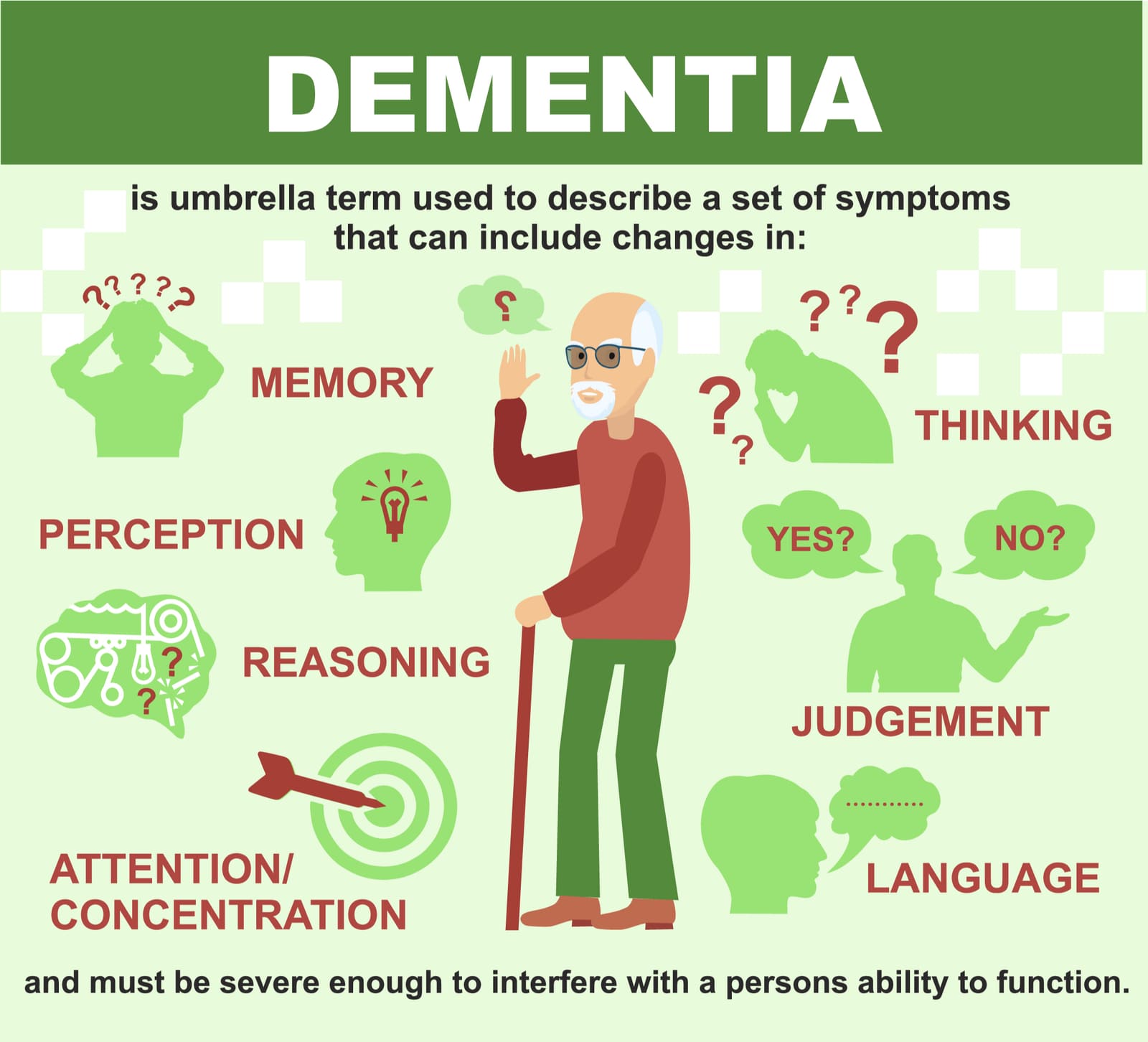
Dementia is a leading global chronic health condition that currently affects about 50 million people worldwide. With people living longer, experts predict that more and more people will be living with dementia in the future—up to as many as 152 million people in 2050.
Dementia isn't always preventable, but there are ways to reduce the risk, manage symptoms, and improve the quality of life of people who have it. Keep reading to learn more.
What is Dementia? Types, Signs, and Symptoms
The World Health Organization defines dementia as a syndrome associated with the "deterioration in memory, thinking, [behavior] and the ability to perform everyday activities." Multiple types of dementia exist, including:
- Alzheimer's disease: accounting for up to 70 percent of all dementia cases, Alzheimer's disease is associated with the build-up of substances in the brain called amyloid plaques and tau tangles as well as decreased connection between nerve cells
- Vascular dementia: considered the second most common type of dementia, vascular dementia develops due to impaired blood flow to the brain
- Lewy body dementia: accounting for about 5 to 10 percent of all dementia cases, Lewy body dementia is due to the abnormal build-up of substances in the brain known as Lewy bodies, named after the man who discovered them
- Mixed dementia: many people with dementia will have more than one type, such as Alzheimer's plus vascular dementia
Additional types of dementia include normal pressure hydrocephalus, Creutzfeldt-Jakob disease (CJD), frontotemporal dementia, Huntington's disease, Parkinson's disease dementia, posterior cortical atrophy, and Korsakoff syndrome.
People with dementia often exhibit a range of signs and symptoms that can vary considerably in terms of type and severity. Because dementia is a progressive disease, symptoms tend to get worse over time. Common signs and symptoms to look out for include:
- Memory loss
- Word-finding difficulties
- Visual and spatial deficits, such as getting lost even in familiar places
- Problems with reasoning, planning, organizing, problem-solving
- Confusion and disorientation
- Problems with coordination and motor control
- Personality changes
- Depression and anxiety
- Inappropriate behaviors
- Paranoia
- Agitation
- Hallucinations
Risk Factors for Dementia
People who develop dementia typically have a combination of risk factors. Some aren't controllable, including advancing age and family history; people with Down syndrome also tend to be more likely to develop Alzheimer's disease.
Many risk factors are controllable, however, meaning you may be able to reduce your risk of dementia by minimizing your exposure to these risk factors. Controllable risk factors include:
- Physical inactivity
- Unhealthy diets, especially diets that are nutrient-poor, excessive in calories, or high in processed foods
- Heavy alcohol consumption
- Obesity
- Cardiovascular problems, including high blood pressure, high cholesterol
- Diabetes
- Smoking
- Sleep disorders, including sleep apnea and chronic sleep deprivation
- Deficiencies in certain nutrients, especially vitamin D and vitamins B6, 12, and 9 (folate)
Treatment for Dementia
Overall, dementia is considered progressive and incurable. But treatment options are available to help manage symptoms, reduce the risk of complications, and improve the safety and quality of life of people affected by this group of conditions.
- Medications, including cholinesterase inhibitors which help boost brain chemicals involved in memory and judgment, and memantine which regulates a brain chemical called glutamate that helps with learning and memory
- Medications to manage related issues, including depression, anxiety, and sleep problems
- Occupational therapy and physical therapy, which can help people with dementia and their caregivers learn compensatory or adaptive strategies to increase safety and manage daily activities, as well as improve their functional mobility
- Lifestyle interventions, including aerobic exercise and a healthy diet—both of which are shown to prevent dementia and/or slow its progression
Do You Know Someone With Dementia?
It's never too late to implement healthier habits that may reduce your risk of dementia and protect your brain health as you age. If you believe you're at risk for dementia or worried about a loved one, talk to your doctor.
In the meantime, be sure to reach out to fellow Healthread readers to share your stories and find some support.
Sources
General information, not medical advice
This article can't account for your health history or current treatment. Talk to a qualified clinician before you change anything about your care.
Read our medical disclaimer →
On this page
What is Dementia? Types, Signs, and Symptoms
Risk Factors for Dementia
Treatment for Dementia
Do You Know Someone With Dementia?
Sources
Put what you read to work
Track your medicines, check a symptom and talk with people managing the same condition, all in Healthread.
Get the app
Keep reading

Mental Health
Bipolar I vs. Bipolar II
Bipolar I and II are the most common types of mental health disorders. While they both share certain similarities, they have two key differences.
August 8, 2024 · 3 min read

Mental Health
Narcissistic Personality Disorder (NPD)
NPD is a mental health condition that is characterized by an inflated opinion of oneself. Someone who is narcissistic may feel more important than other people.
May 4, 2024 · 3 min read

Mental Health
What is Treatment-Resistant Depression?
Treatment-resistant depression is a form of major depressive disorder that fails to respond to the standard depression treatments involving taking an anti-depressant or going to psychotherapy.
February 3, 2024 · 3 min read


© 2026 Healthread
English · Español
Healthread does not provide medical advice, diagnosis or treatment. Always speak to a qualified clinician about your care.