

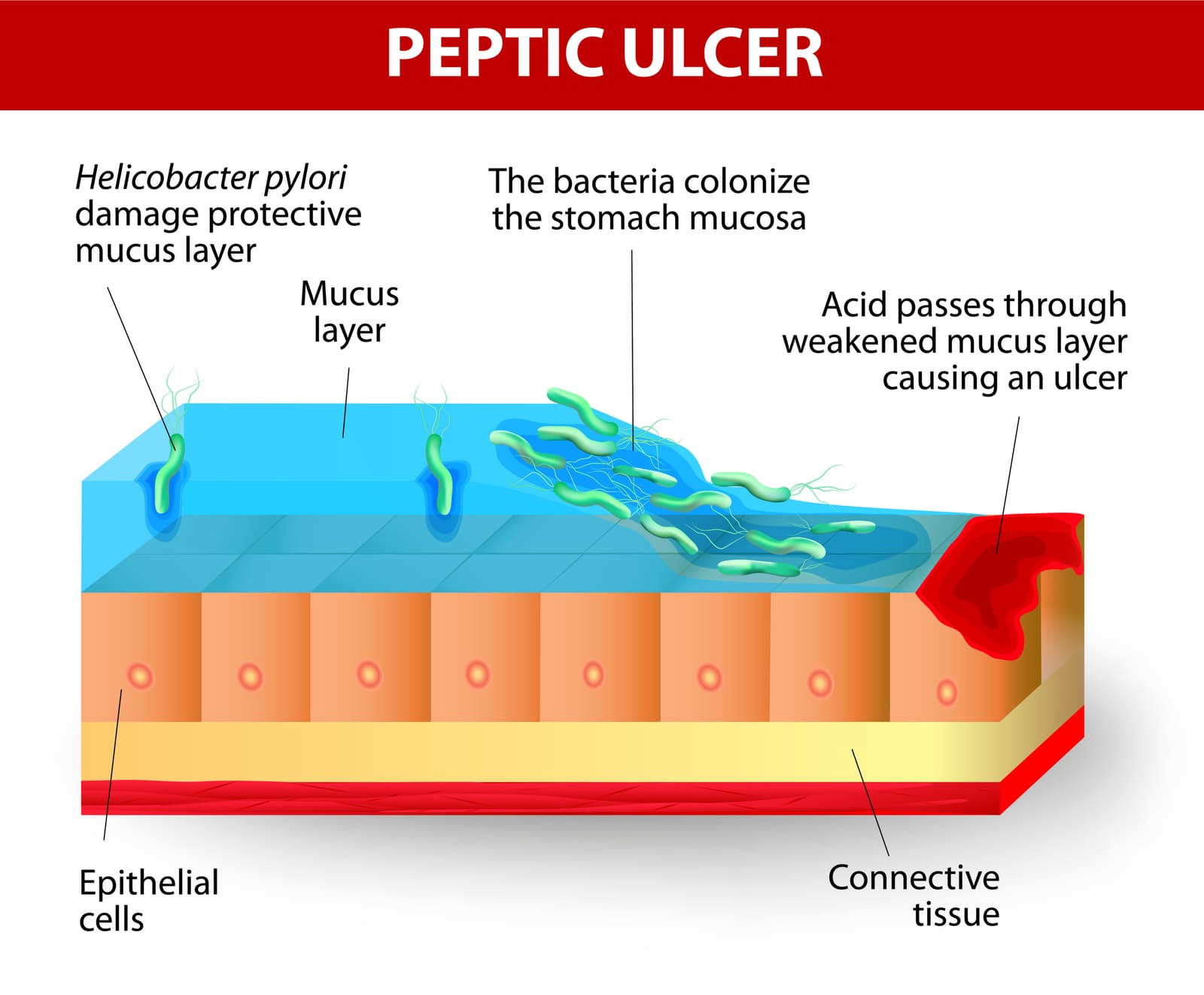
Helicobacter pylori, or H. pylori, is a bacterial infection harbored by about half the world’s population. It is a leading cause of peptic ulcers and other digestive diseases and may contribute to stomach cancer.
Most people are infected with H. pylori in childhood. While the majority of those infected remain asymptomatic, the bacteria can affect the stomach lining and the duodenum, or the initial part of the small intestine. That eventually leads to ulcers or gastritis. The latter refers to stomach inflammation.
H. pylori creates an enzyme known as urease. This enzyme neutralizes stomach acids, which has the effect of weakening the lining and inflaming the stomach.
H. Pylori Spread
Exactly how H. pylori spreads is uncertain. Researchers believe it may spread via consuming uncooked or contaminated food. The same holds true for drinking water containing the bacteria.
It is possible the bacteria spread by contact with vomit or feces, or by kissing or any other saliva exchange.
Peptic Ulcer Symptoms
An ulcer wears a hole in the stomach wall. Depending on its location, it can also prevent food from leaving the stomach.
Suspect a peptic ulcer if experiencing burning stomach pain. The pain most often occurs on an empty stomach and may last for a few minutes or hours. It is not uncommon for the pain to come and go for days or weeks at a time. Attacks frequently happen at night, also disturbing sleep. Other symptoms include:
- Bloating
- Burping
- Loss of appetite
- Nausea
- Vomiting
- Weight loss
Anyone developing bloody or tarry stools should contact their doctor immediately. That is indicative of bleeding in the gastrointestinal tract. Also call the doctor if having trouble swallowing or the abdominal pain becomes severe.
H. Pylori and Stomach Cancer
Stomach cancer is the seventh most common cause of cancer death in the U.S. Early detection is critical to prevent the spread of the disease and fatality. The changes wrought in the stomach lining by H. pylori is a major risk factor for developing stomach cancer. Anyone with a family history of stomach cancer should undergo H. pylori testing, even if they have no symptoms of gastrointestinal disease.
Risk Factors
In the United States, between 30 and 40 percent of the population is infected with H. pylori. Approximately half of the infected individuals are age 50 and up.
While about 50 percent of African-Americans have the bacteria in their systems, that is also true of Latinos and those emigrating to the U.S. from Eastern Europe.
Those living with people with H. pylori infection are more likely to become infected.
Because making sure all food is clean and cooked properly, it is also critical to wash hands thoroughly after using the bathroom to reduce the risk of H. pylori spread. While children are most vulnerable to picking up H. pylori, adults can also contract the bacteria.
Diagnosing H. Pylori
Diagnosing H. pylori is generally straightforward. A blood test reveals whether antibodies are present, showing exposure to the bacteria. Lab tests performed on stool samples will also indicate the presence of H. pylori.
A healthcare provider may give a patient a urea pill. This pill contains carbon molecules. A breath test is then performed. If the test reveals carbon, that means the bacteria has made urease.
A biopsy taken during an upper endoscopy will also confirm the presence of H. pylori. An upper endoscopy consists of the insertion of a small, lighted tube with a tiny camera at one end into the mouth and throat. It is then guided down through the esophagus and stomach as far as the duodenum. The doctor can view the gastrointestinal tract and look for ulcers and other issues. A tiny sample of stomach tissue is removed for biopsy via minute forceps placed in the endoscope.
The procedure is performed under sedation or, less often, under general anesthesia. Endoscopies are not usually given solely to detect the bacteria but to see if ulcers or other gastrointestinal disorders are present.
H. Pylori Treatment
People experiencing peptic ulcer pain may find temporary relief by taking antacids. That, however, is not a long-term solution. Medications are available to effectively treat H. pylori.
These drugs may include H-2 blockers, which block histamine. This hormone makes stomach acid, and H2-blockers reduce excess stomach acid. Cimetidine, marketed under the brand name Tagamet, is an H-2 blocker.
Stomach lining protectors work as the name suggests. These medications kill bacteria while protecting the stomach’s p. Proton pump inhibitors reduce acid production. Examples include omeprazole, or Prilosec; esomeprazole, or Nexium; lansoprazole, or Prevacid, and pantoprazole, or Protonix.
About a month post-treatment, your doctor may perform another carbon breath test or request a stool sample for testing to ensure the infection is gone. If H. pylori are still present, another round of treatment is necessary.
Once H. pylori are eradicated, gastritis should heal. Treatment lowers the risk of developing peptic ulcers and stomach cancer.
Sources
General information, not medical advice
This article can't account for your health history or current treatment. Talk to a qualified clinician before you change anything about your care.
Read our medical disclaimer →
On this page
H. Pylori Spread
Peptic Ulcer Symptoms
H. Pylori and Stomach Cancer
Risk Factors
Diagnosing H. Pylori
H. Pylori Treatment
Sources
Put what you read to work
Track your medicines, check a symptom and talk with people managing the same condition, all in Healthread.
Get the app
Keep reading

Cancer-Updates
Gynecologic Cancer
Gynecologic cancer is a term used to describe a group of cancers that affect the female reproductive system. There are five types of gynecologic cancers named after the body part where they start.
November 5, 2024 · 3 min read

Cancer-Updates
Anal Cancer
Anal cancer is caused when the cancer cells in the anus grow uncontrollably, forming masses or tumors. The cancer cells can sometimes spread to other body parts, causing metastatic cancer.
August 18, 2024 · 3 min read

Cancer-Updates
Bile Duct Cancer (Cholangiocarcinoma)
Bile duct cancer, or cholangiocarcinoma, is a cancer that occurs in the bile ducts, the slender tubes that collect bile, a fluid made by the liver for breaking down fats in the digestion process.
April 17, 2024 · 2 min read


© 2026 Healthread
English · Español
Healthread does not provide medical advice, diagnosis or treatment. Always speak to a qualified clinician about your care.