

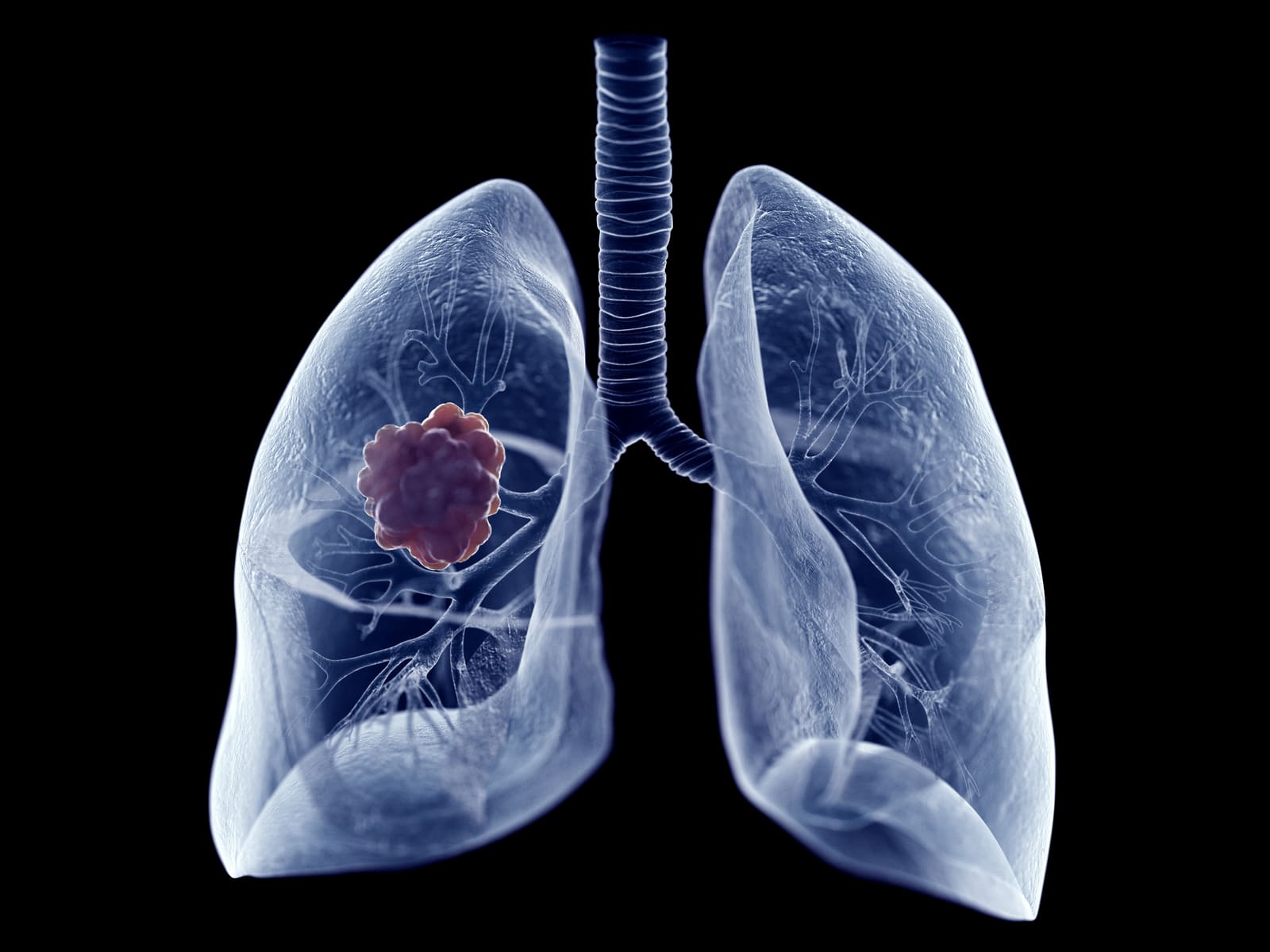
Lung cancer is a serious condition and often deadly that affects the respiratory tract. Doctors diagnose about 236,740 new cases of lung cancer each year; the condition causes about 130,180 deaths annually. Accounting for about 25 percent of all cancer deaths, lung cancer is by far the leading cause of cancer death.
Lung cancer can affect any part of the lungs, which are two sponge-like organs in the chest. The right lung has three sections, known as lobes, while the left lung has two sections. The left lung is smaller because the heart takes up more room on that side of the chest.
When you breathe in, air enters your nose or mouth and moves through your trachea (windpipe) into your lungs. The trachea splits into two tubes, known as the left and right bronchi, which then divide into smaller bronchi inside your lungs. These bronchi continue to divide to form bronchioles. Situated at the ends of each bronchioles are alveoli, which are tiny air sacs that do the important work of taking in oxygen and getting rid of carbon monoxide.
Lungs contain many different types of cells. Most cells in the lungs are epithelial cells that line the airways. These cells make mucus that lubricates and protects the lung. Lungs also contain lymph nodes, which are glands that filter body fluid and fight infections.
Cancer is a condition in which abnormal cells grow uncontrollably; these abnormal cells may ultimately spread to other parts of the body. In lung cancer, abnormal lung cells begin to grow in the bronchial tubes, bronchioles or alveoli, and spread to other parts of the body. Cancer cells can grow in the epithelial cells or in the lymph nodes.
Medical professionals discuss cancer in terms of size of the tumor and whether it has spread from its primary, or original, location to other parts of the body. They describe the spread of cancer, or metastasis, in terms of stages. In stages 0 and 1, cancer has not yet spread. Stage 2 cancer, also known as locally advanced cancer, has spread to lymph nodes or nearby tissue. In stage 4, the lung cancer cells have spread to more than one area of the lung or to distant parts of the body.
They describe cancer that has spread only to nearby tissue or lymph nodes as locally advanced cancer, for example, and refer to cancer that has spread to faraway tissue as metastatic cancer. Localized cancer is easier to treat than is cancer that has spread, or metastasized, and localized lung cancer usually has a better prognosis.
While each patient is different, doctors can often predict the prognosis, which is the likely outcome. Medical professionals offer prognoses in terms of 5-year survival rates that describe the percentage of people with lung cancer that survive for 5 years after receiving their diagnosis. The overall 5-year survival rate for lung cancer is 18.6 percent, according to the American Lung Association. Unfortunately, more than half of all people diagnosed with lung cancer die within a year of their diagnosis.
Types of Lung Cancer
Medical professionals categorize lung cancer in several ways. Cancer cells that originate in the epithelial cells are known as carcinomas, for example, while those that start in lymph nodes are known as adenocarcinomas.
There are two main types of lung cancer, and several sub-types. Each affects the lungs differently and presents a different prognosis.
Non-small cell lung cancer
Non-small cell lung cancer (NSCLC) is the most common type, accounting for between 80 to 85 percent of lung cancer cases, according to the American Cancer Society. The main subtypes of non-small cell lung cancer include:
- Adenocarcinoma – starts in cells that normally secrete mucus and other substances
- Squamous cell carcinoma – starts in the squamous cells, which are flat cells that line the inside of the airways in the lungs; often linked to a history of smoking, these cancer cells are usually located in the central part of the lungs, near one of the bronchi
- Large cell (undifferentiated) carcinoma – a fast-growing, quick-spreading carcinoma that can appear in any part of the lung
Small cell lung cancer (SCLC)
Also known as oat cell cancer, small cell lung cancer (SCLC) account for about 10 to 15 percent of all lung cancers. SCLC tends to grow and spread faster than non-small cell lung cancers. This type of cancer will have already metastasized in about 70 percent of people by the time they are diagnosed.
Lung carcinoid tumors
Carcinoid tumors of the lung are rare, accounting for fewer than 5 percent of all lung cancer cases. These tumors grow slowly.
For more information about lung cancer, its types and prognosis, consult with a medical professional. Cancer treatment has come a long way in the past few decades, and even if it is not curable, it is almost always treatable.
General information, not medical advice
This article can't account for your health history or current treatment. Talk to a qualified clinician before you change anything about your care.
Read our medical disclaimer →
Put what you read to work
Track your medicines, check a symptom and talk with people managing the same condition, all in Healthread.
Get the app
Keep reading

Cancer-Updates
Gynecologic Cancer
Gynecologic cancer is a term used to describe a group of cancers that affect the female reproductive system. There are five types of gynecologic cancers named after the body part where they start.
November 5, 2024 · 3 min read

Cancer-Updates
Anal Cancer
Anal cancer is caused when the cancer cells in the anus grow uncontrollably, forming masses or tumors. The cancer cells can sometimes spread to other body parts, causing metastatic cancer.
August 18, 2024 · 3 min read

Cancer-Updates
Bile Duct Cancer (Cholangiocarcinoma)
Bile duct cancer, or cholangiocarcinoma, is a cancer that occurs in the bile ducts, the slender tubes that collect bile, a fluid made by the liver for breaking down fats in the digestion process.
April 17, 2024 · 2 min read


© 2026 Healthread
English · Español
Healthread does not provide medical advice, diagnosis or treatment. Always speak to a qualified clinician about your care.