

For patients facing cancer for the first time, the terminology can sound like a foreign language. Here, we'll share everything you need to know about non-small-cell lung cancer in words you can understand so you're on board with the treatment plan and hopeful for the future.
The basics
Non-small-cell lung cancer is the most common variation of lung cancer; it's counterpart is called small cell lung cancer. The difference between the two, as suggested by their names, is the size of the cancer cells, and therefore staging, treatment options and outlook. People with non-small-cell cancer have more treatment options and a better survival rate than those with small cell lung cancer. This article expands on the differences between small and non-small-cell in an easy-to-understand format to support your learning.
Risk factors
Risk factors aren't fully understood by the medical community yet, but we do know that those who have a history of smoking, HIV, or radiation treatment to the chest and those who have been exposed to radon, mineral or metal dust, air pollution, or asbestos seem to be at higher risk of developing non-small-cell lung cancer.
Knowing your risk factors is important for two reasons: 1) you may have some control over some risk factors and reduce them, like smoking, and 2) you may be more alert to signs and symptoms knowing that you're at higher risk of developing the disease.
Signs and symptoms
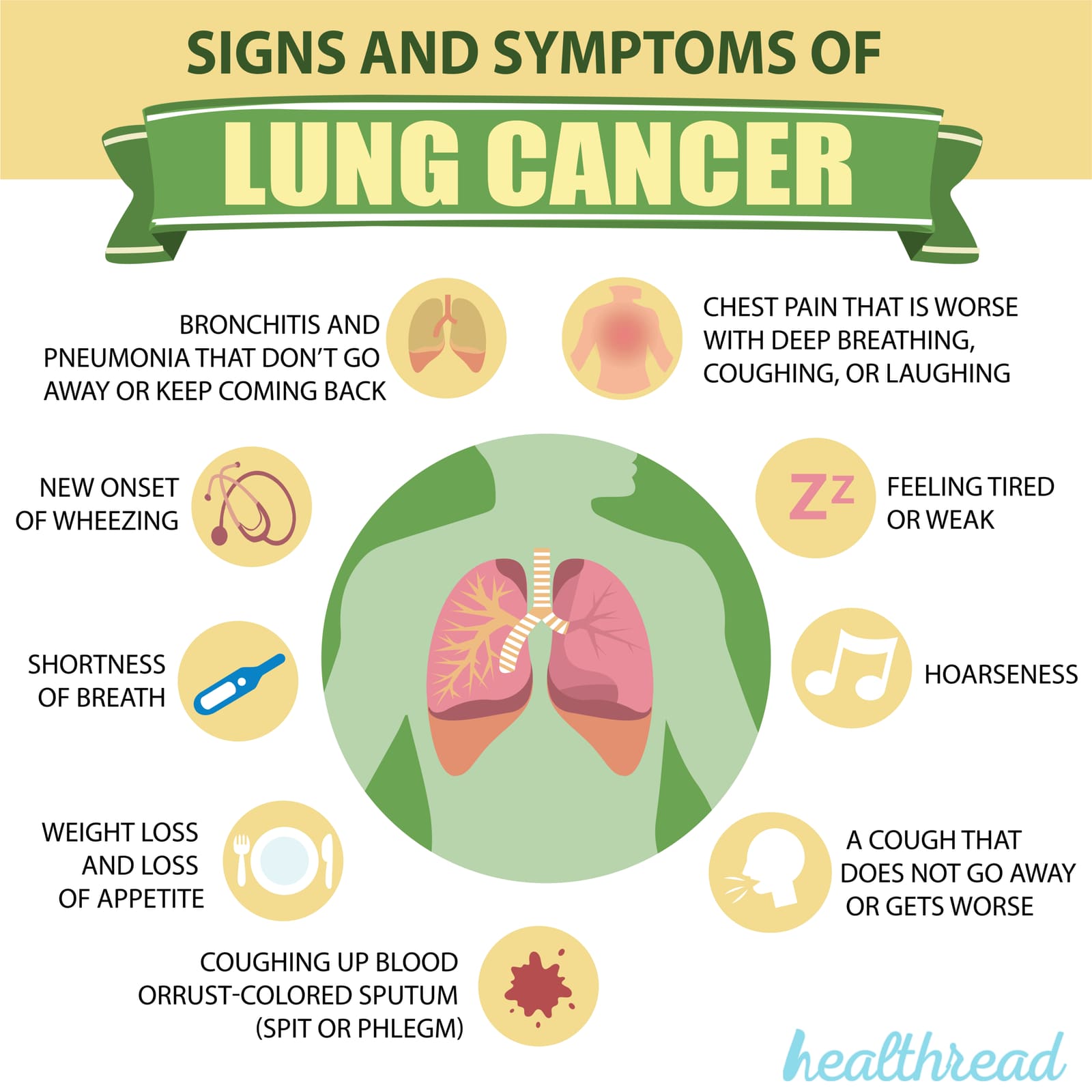
Every patient experiences non-small-cell lung cancer a little differently, but the signs and symptoms that are seen across the greatest number of patients include:
- coughing up blood or blood-tinged sputum
- hoarseness
- chest pain that worsens with laughing, coughing, or when you take a deep breath
- unintentional weight loss
- a cough that doesn't go away
- shortness of breath
- fatigue, weakness, or tiredness
- repeat or chronic bronchitis or pneumonia
Because lung cancer can spread to other parts of the body, some patients have symptoms that don't seem to be related like back pain, hip pain, dizziness, problems with balance, jaundice, or swollen lymph nodes.
Diagnosis
If you have signs and symptoms of lung cancer, whether the risk factors apply to you or not, you should schedule an appointment with your primary care provider as soon as possible. Your primary care provider will work to rule out other common conditions that can produce the same symptoms and will likely order both lab tests and imaging tests and perform a physical examination.
The most common imaging tests used to diagnose or rule out lung cancer include CT scan, PET scan, MRI, and bone scan. If something is detected in those images, a procedure like biopsy, bronchoscopy, or thoracentesis may be required to collect and diagnose tissue.
Treatment
Those with non-small-cell lung cancer typically have more treatment options than those with small-cell lung cancer. Treatment options will depend on a number of factors but might include surgery, chemotherapy, targeted treatments, immunotherapy, radiation, or endoscopic stents. Not all of these treatments are available to every patient.
Most patients with localized non-small-cell cancer are still living five years after their diagnosis, which treatment options are often successful in extending life.
Sources
- 1medicalnewstoday.com/articles/316477#symptoms
- 2webmd.com/lung-cancer/non-small-cell-lung-cancer#1
- 3cancer.org/cancer/lung-cancer/detection-diagnosis-staging/signs-symptoms.html
- 4cancer.net/cancer-types/lung-cancer-non-small-cell/diagnosis#:~:text=1%20Imaging%20tests.%20Imaging%20scans%20are%20very%20important,a%20NSCLC%20diagnosis.%20...%205%20Stopping%20smoking.%20
- 5medicalnewstoday.com/articles/316477#outlook
General information, not medical advice
This article can't account for your health history or current treatment. Talk to a qualified clinician before you change anything about your care.
Read our medical disclaimer →
Put what you read to work
Track your medicines, check a symptom and talk with people managing the same condition, all in Healthread.
Get the app
Keep reading

Cancer-Updates
Gynecologic Cancer
Gynecologic cancer is a term used to describe a group of cancers that affect the female reproductive system. There are five types of gynecologic cancers named after the body part where they start.
November 5, 2024 · 3 min read

Cancer-Updates
Anal Cancer
Anal cancer is caused when the cancer cells in the anus grow uncontrollably, forming masses or tumors. The cancer cells can sometimes spread to other body parts, causing metastatic cancer.
August 18, 2024 · 3 min read

Cancer-Updates
Bile Duct Cancer (Cholangiocarcinoma)
Bile duct cancer, or cholangiocarcinoma, is a cancer that occurs in the bile ducts, the slender tubes that collect bile, a fluid made by the liver for breaking down fats in the digestion process.
April 17, 2024 · 2 min read


© 2026 Healthread
English · Español
Healthread does not provide medical advice, diagnosis or treatment. Always speak to a qualified clinician about your care.