

According to the Oral Cancer Foundation (OCF), approximately 450,000 people (54,000 people in the US alone) are diagnosed with oral or oralpharygeal (mouth and throat) cancers each year. These cancers are a serious public health concern, because the death rate is higher than for other common cancers that people commonly hear about (e.g., cervical cancer, Hodgkin’s lymphoma, breast cancer, prostate cancer). Five years after diagnosis, 57% of patients with oral cancer will still be alive. Progress will continue to be made in new treatments, but the high death rate illustrates the importance of prevention and early detection, which increases the likelihood of sucessful treatment.
Oral cancers can form on any soft tissue in the oral cavity, including the tongue, gums, inside of the cheeks, roof of the mouth, and under the tongue. The cancers often begin in the cell layer that lines the inside of the moist areas of the mouth, called the squamous cells. While cancers can develop in the salivary glands, this is much rarer than with other oral structures.
Causes and Symptoms of Oral Cancers
Most oral cancers are associated with human papilloma virus (HPV) infection or chronic/heavy use of alcohol and tobacco. Extensive sun exposure also increases the risk of developing cancer on the lips. For all causes, the risk increases with age.
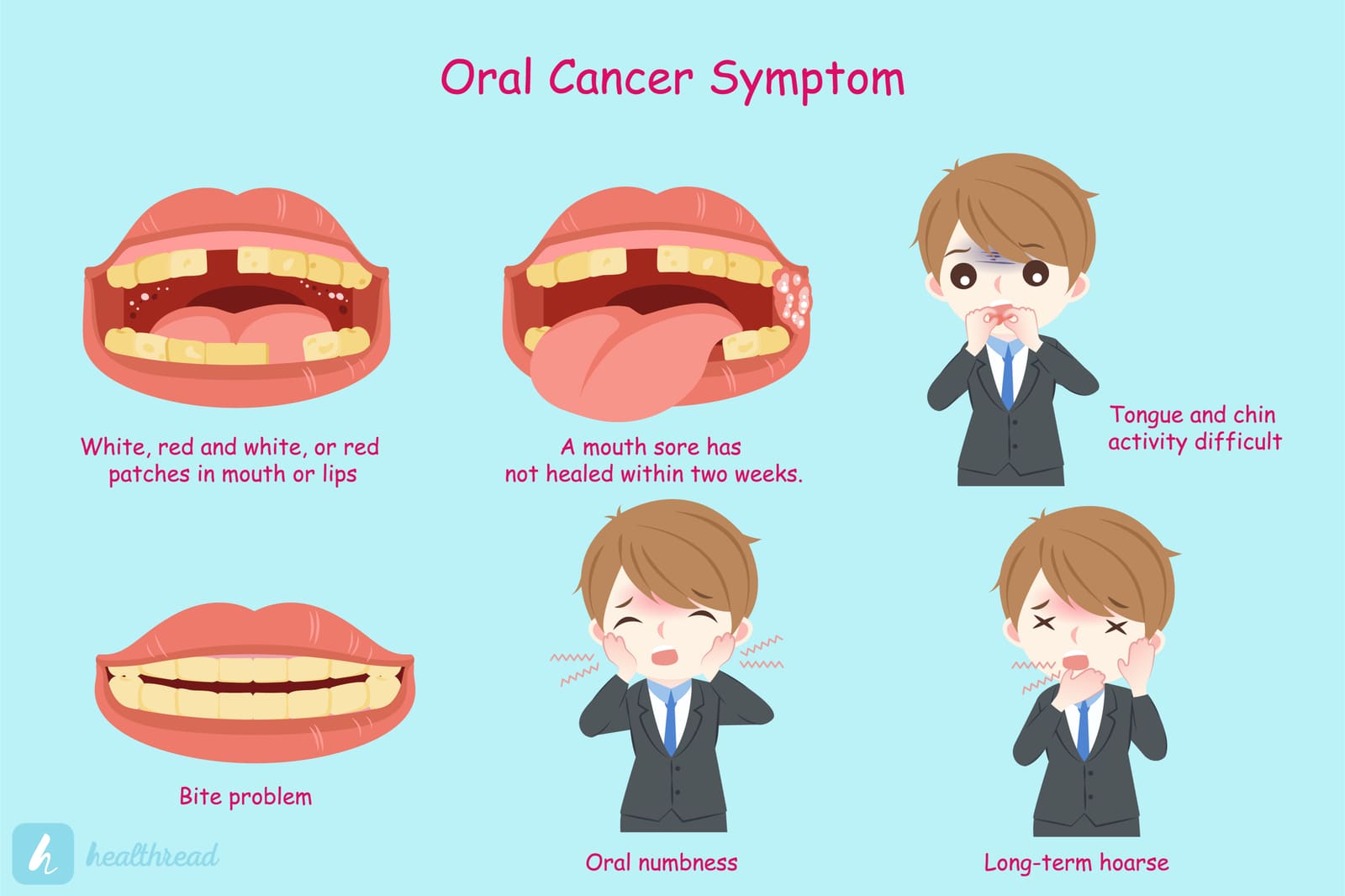
Common symptoms include:
- White or red sores, lumps, or thick patches on the lips, mouth, or throat
- A feeling that something is caught in the throat
- Soreness, swelling, or numbness in the mouth or throat
- Difficulty swallowing, chewing food, or talking
- Dentures that no longer fit properly due to swollen tissues in the jaw
- Ear pain
If any of these symptoms last more than 2 weeks, a doctor or dentist should be consulted to rule out the possibility of oral cancer. You can familiarize yourself with the kinds of lesions that may be oral cancer by viewing images on the website of the OCF.
Diagnosing Oral Cancers
Early detection is essential, because oral cancers can progress quickly. They have a tendency to spread, and the survival rate is best if treatment begins before the cancer has a chance to spread outside the mouth. Most dental offices perform a screen for oral cancers during routine cleaning appointments. A physical exam will check the inside of the cheeks, palate, lips, gum, and tongue for signs of irregular tissue. The neck lymph nodes will be checked to identify swelling (signs of an immune response against the cancer or spreading tumor cells). If an oral cancer is suspected, the dentist may refer you to a specialist for additional testing, which may include:
- Taking a scrape of the inside of the mouth or lips to look under the microscope for abnormal looking cells.
- Taking a biopsy (tissue sample) to look under the microscope for signs of cancer cells.
- Imaging studies (e.g., x-rays, MRI, CT, PET) to understand the location of the tumor and extent of spread.
Cancers are staged to provide information about how advanced they are, which informs on the best treatment for the situation.
- Stage 0 (carcinoma in situ): Abnormal cells are present but there is no tumor. These cells have the potential to become cancerous.
- Stage 1: A tumor has formed. It is less than 2 centimeters (the size of a peanut) wide and it has reached 5 millimeters (width of a pencil eraser) or less into the surrounding tissue.
- Stage 2: A tumor has formed. It is 2 centimeters or less but has reached more than 5 millimeters into the surrounding tissue; or it between 2 to 4 centimeters (the size of a peanut to a walnut) wide and has reached 10 millimeters (the size of a pea) or less into the surrounding tissue.
- Stage 3: A tumor is found that meets one of the following criteria:
- Between 2 and 4 centimeters wide and has reached at least 10 millimeters into the surrounding tissue.
- Larger than 4 centimeters and has reached 10 millimeters or less into the surrounding tissue.
- Has a secondary tumor in one lymph node on the same side of the body as the primary tumor. The secondary tumor is 3 centimeters (the size of a grape) or less.
- Stage 4: This stage is further dividend into multiple substages of increasing severity (Stages 4A through 4D). In general, cancers in this stage are larger than 4 centimeters (the size of a walnut) and have spread beyond their original location.
Treating Oral Cancers
The treatment is highly individualized, depending on the size and type of tumor, and whether the cancer has spread to other parts of the body. Surgical removal of the oral tumor is often the first step in treatment. Radiation therapy and chemotherapy may also be used to kill any cancer cells left behind after the surgery. Depending on the extent of the cancer, dental surgeons may be needed to reconstruct damaged areas and restore function or improve cosmetic outcomes.
For some patients, clinical trials may be an option. These experimental therapies are not guaranteed to provide a benefit, but they contribute to the overall medical progress for treating these kinds of cancers. Clinical trials can involve experimental therapies aimed at curing or preventing the cancer from returning. Information on available clinical trials in the United States can be obtained from a physician or by looking at opportunities at the National Cancer Institute’s or FDAs ClinicalTrials.gov website.
Sources
General information, not medical advice
This article can't account for your health history or current treatment. Talk to a qualified clinician before you change anything about your care.
Read our medical disclaimer →
Put what you read to work
Track your medicines, check a symptom and talk with people managing the same condition, all in Healthread.
Get the app
Keep reading

Cancer-Updates
Gynecologic Cancer
Gynecologic cancer is a term used to describe a group of cancers that affect the female reproductive system. There are five types of gynecologic cancers named after the body part where they start.
November 5, 2024 · 3 min read

Cancer-Updates
Anal Cancer
Anal cancer is caused when the cancer cells in the anus grow uncontrollably, forming masses or tumors. The cancer cells can sometimes spread to other body parts, causing metastatic cancer.
August 18, 2024 · 3 min read

Cancer-Updates
Bile Duct Cancer (Cholangiocarcinoma)
Bile duct cancer, or cholangiocarcinoma, is a cancer that occurs in the bile ducts, the slender tubes that collect bile, a fluid made by the liver for breaking down fats in the digestion process.
April 17, 2024 · 2 min read


© 2026 Healthread
English · Español
Healthread does not provide medical advice, diagnosis or treatment. Always speak to a qualified clinician about your care.