

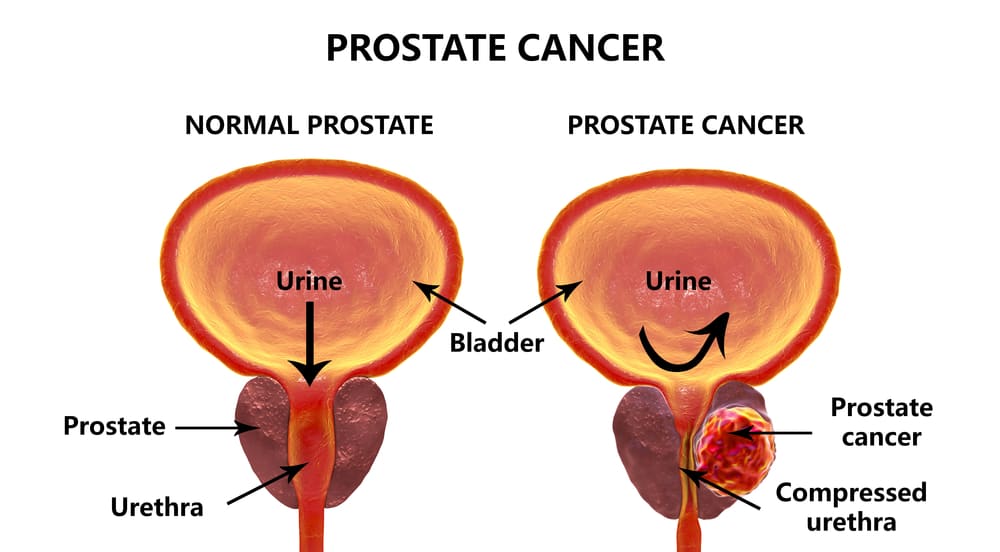
Approximately 1 in 9 men will receive a prostate cancer diagnosis in their lifetimes. The good news is that even though prostate cancer is the second leading cause of cancer death in males, it is generally a slow-growing disease.
The walnut-shaped prostate gland sits next to the bladder and in front of the rectum.
While one of the most common cancers in males, most men with prostate cancer will succumb to something else. However, some types of prostate cancer are more aggressive, so men should visit a doctor as soon as possible after symptoms appear. Early detection and treatment usually mean a better prognosis.
Prostate Cancer Symptoms
Prostate cancer causes few symptoms in the early stages. As the cancer progresses, the following symptoms frequently appear:
- Frequent urination
- Weaker urinary stream
- Erectile dysfunction
- Pelvic discomfort
- Blood in semen
Men with advanced cases of prostate cancer may experience bone pain. Prostate cancer often metastasizes to the bones.
Risk Factors
Prostate cancer primarily affects older men. African-American men are at higher risk of developing prostate cancer and are more often diagnosed at an advanced stage. Obese men are also at greater risk of advanced disease.
There is a genetic component to prostate cancer, so if your father or grandfather suffered from the disease, your risk of developing it increases.
Prostate Cancer Diagnosis
Screening tests for prostate cancer include a digital rectal exam to determine the size of the prostate gland and a Prostate Specific Antigen (PSA) test. The latter requires a blood sample. High levels of PSA may indicate potential cancer.
If these tests show some abnormality, the next step is an ultrasound for further prostate evaluation. The urologist may also conduct a biopsy to collect cells from the prostate gland. The biopsy will determine whether the cancer is aggressive based on its grade.
When a diagnosis of prostate cancer is made, further tests are necessary to see if the disease has spread. These include:
- Bone scan
- CT scan
- MRI
- PET scan
Prostate Cancer Treatment
Many men diagnosed with prostate cancer will not need treatment per se, at least not immediately. Instead, they undergo regular PSA testing and surveillance by their doctors.
Some men will undergo surgery to remove the prostate. Risks of this procedure include erectile dysfunction and urinary incontinence.
Another treatment option is radiation therapy. This may consist of external beam radiation designed to kill cancer cells, or brachytherapy, the implantation of numerous radioactive seeds in the prostate gland.
Men who go through external beam radiation should expect to undergo this therapy five days a week for several weeks. The radioactive seeds in brachytherapy emit low-levels of radiation constantly to kill cancer cells, and will eventually stop radiation emission. Once the seeds are implanted, removal is not necessary.
Some men may benefit from hormone therapy that stops the production of testosterone. Prostate cancer requires this male hormone to grow. Medications are available that stop testosterone production per se, or prevent the hormone from reaching cancer cells.
Men with advanced cases of prostate cancer may undergo chemotherapy or immunotherapy.
Sources
General information, not medical advice
This article can't account for your health history or current treatment. Talk to a qualified clinician before you change anything about your care.
Read our medical disclaimer →
On this page
Prostate Cancer Symptoms
Risk Factors
Prostate Cancer Diagnosis
Prostate Cancer Treatment
Sources
Put what you read to work
Track your medicines, check a symptom and talk with people managing the same condition, all in Healthread.
Get the app
Keep reading

Cancer-Updates
Gynecologic Cancer
Gynecologic cancer is a term used to describe a group of cancers that affect the female reproductive system. There are five types of gynecologic cancers named after the body part where they start.
November 5, 2024 · 3 min read

Cancer-Updates
Anal Cancer
Anal cancer is caused when the cancer cells in the anus grow uncontrollably, forming masses or tumors. The cancer cells can sometimes spread to other body parts, causing metastatic cancer.
August 18, 2024 · 3 min read

Cancer-Updates
Bile Duct Cancer (Cholangiocarcinoma)
Bile duct cancer, or cholangiocarcinoma, is a cancer that occurs in the bile ducts, the slender tubes that collect bile, a fluid made by the liver for breaking down fats in the digestion process.
April 17, 2024 · 2 min read


© 2026 Healthread
English · Español
Healthread does not provide medical advice, diagnosis or treatment. Always speak to a qualified clinician about your care.