

TMS and Electroshock Treatment for Severe Depression
August 22, 2020
5 min read
Depression is treatable! We know that psychotherapy, medications, and healthy lifestyle changes like exercise and a nutrient-rich diet are effective ways to alleviate and treat depression. But in some cases, depression may be so severe and disruptive that other types of treatment may be necessary.
This is where brain stimulation comes in. In this post, we're introducing two types of depression treatments that are often beneficial in people with more advanced cases of depression: transcranial magnetic stimulation (TMS) and electroconvulsive therapy (ECT). Keep reading to learn more.
What is Electroconvulsive Therapy (ECT)?
According to Mayo Clinic, electroconvulsive therapy (ECT, sometimes also called electroshock therapy) is a type of depression treatment that involves the passing of electrical currents through the brain. Electroconvulsive therapy (ECT) uses a small electric current to produce a generalized cerebral seizure under general anesthesia. This doesn't damage the brain. Instead, it affects the way certain parts of the brain functions and releases different neurotransmitters that can affect mood.
ECT is usually indicated for people who haven't responded to medications like antidepressants (so-called "treatment-resistant" depression) or can't take antidepressant medications due to health reasons. ECT may also be beneficial for people with severe depression or those who are at high risk of suicide. ECT is also indicated in other conditions such as schizophrenia, bipolar disorder and catatonia.
Although the exact mechanism of action of ECT is unknown it appears increase the release of neurotransmitters such as dopamine and norepinephrine in the brain. ECT may also cause increase release of some hormones from the hypothalamus and pituitary gland. ECT appears to reverse atrophic brain shrinkage caused by severe depression an may also cause change in brain connectivity. In some cases, genetics factors may affect the response to ECT.
Thanks to advances in techniques and technologies, ECT is much safer now than it was several decades ago when it was first introduced. Today, people undergoing ECT are put under anesthesia to keep them calm and unaware of the procedure as its going on. They are also closely monitored with machines and direct medical supervision to ensure the procedure goes smoothly. Electrical currents are passed into the brain through electrodes that are attached to the head. The general prescription for ECT is about two to three times per week for up to one month.Most patients remit with 6 to 12 treatments, but some require only three while others require 20 or more. After remission however, ongoing continuation and maintenance treatments are frequently indicated. Many Psychotropic medications such as antidepressants, antipsychotics and lithium can be continued during ECT but these should be discussed with your physician prior to ECT.
While ECT doesn't work for everyone, most people see improvements in their depression symptoms within six treatment sessions. According to the American Psychiatry Association, about 80 percent of people who undergo ECT will notice significant improvements! Side effects are possible, and can include temporary confusion, memory loss, nausea, headaches. Concerns about problems with cognition primarily memory loss is a major impediment for using ECT. Although memory loss can occur in a significant portion of patients the risks appears to be higher in females, patients age 18-39 years those with previous memory problems and those on lithium. Some of the lost memories of events prior to the course of ECT may be expected to return, while others may not. The typical ECT patient is profoundly depressed and is willing to accepts some degree of memory loss as a reasonable tradeoff for resolution of their depressive episode. It does not appear that ECT is associated with an increased risk of dementia
People with certain health conditions, including chronic heart problems, pulmonary problems and disorders of central nervous system may be more at risk of side effects or complications. So, it's important to speak closely with a doctor before undergoing ECT to help figure out if it's the best treatment for you or your loved one.
What is Transcranial Magnetic Stimulation (TMS)?
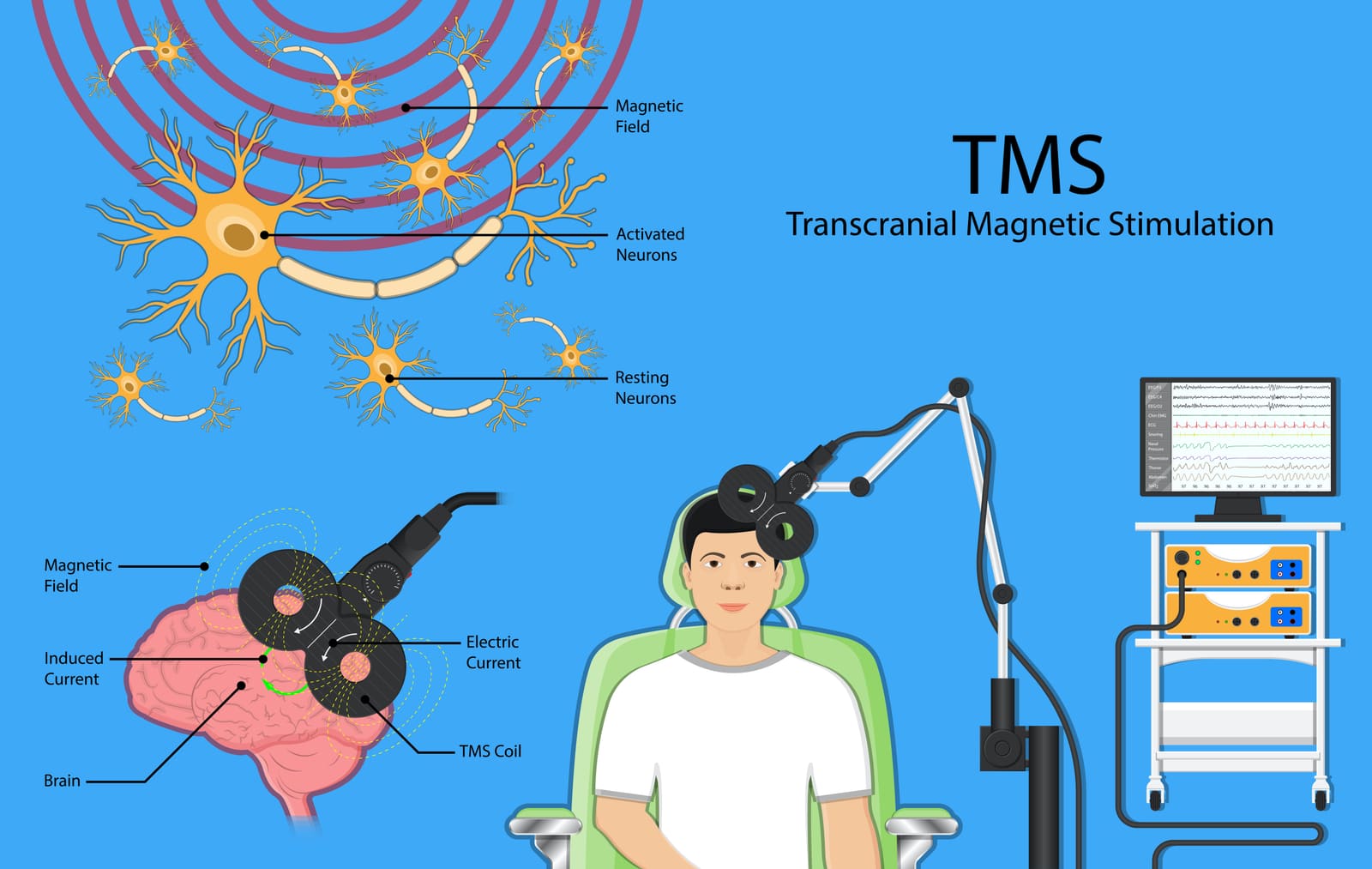
Like ECT, transcranial magnetic stimulation (TMS) is another good option for people with depression who haven't responded to antidepressants. It's non-invasive and drug-free. During a TMS session, a coil that emits electromagnetic waves is placed against a person's scalp, near the forehead. This coil delivers repetitive magnetic pulses to areas of the brain that control mood and stimulate nerve cells that are usually underactive in people who are depressed. The electrical currents produced stimulate nerve cells involved in mood regulation that may be underactive in diseases such as depression. By restoring the equilibrium, TMS helps reset this imbalance of chemicals. from a diseased brain to a healthy one.
We don't know exactly why TMS works. But research shows it can be effective for many people with treatment resistant depression. TMS can be used as an add on to medications for treatment of depression. In addition, simultaneously starting TMS with pharmacotherapy be superior to medication alone in the treatment of major depression. Approximately 50% to 60% of people with depression who have tried and failed to receive benefit from medications experience a clinically meaningful response with TMS. About one-third of these individuals experience a full remission, meaning that their symptoms go away completely.
TMS is being studied extensively across disorders and even disciplines with the hope that it will evolve into new treatments for neurological disorders, pain management, and physical rehabilitation in addition to psychiatry. There are currently large clinical trials looking at the effectiveness of TMS in conditions such as pediatric depression, bipolar disorder, obsessive-compulsive disorder, smoking cessation, and post-traumatic stress disorder. In many European countries, however, TMS is approved for a multitude of other common conditions including: Anxiety, PTSD, Schizophrenia, parkinsonism, Alzheimer’s, Chronic pain and nicotine addiction.
TMS is non-invasive and requires no anesthesia or sedation. The procedure typically lasts less than an hour. During this time patients are awake, alert and comfortable. There are no restrictions on work or other activity before the treatment. Patients typically receive 20 to 30 treatments over four to six weeks (five times per week). There may also be a taper phase. The course of treatment will vary according to each individual. In addition, some patients can elect to have maintenance treatment with TMS. In responders who later relapse TMS can b also be repeated.
TMS is considered safe and generally well-tolerated but may cause mild side effects like scalp discomfort at the site of electrode placement, tingling or twitching in the face muscles, lightheadedness, and headaches. Uncommon side effects include temporary hearing impairment, seizures and mania.
The advantage to TMS compared with ECT is that patients are fully awake and do not require any sedation, and there is no concern about memory impairment with TMS. Also, Patients who have failed ECT can also opt to have TMS. However, ECT remain the gold standard for treatment of severe and resistant depression.
Depressed? Find Your Treatment, Find Your Support Team
While ECT and TMS may sound like science fiction, these depression treatments have helped millions of people around the world who are suffering. If you're interested in learning more about brain stimulating treamtents for depression, talk to your provider. Have firsthand experience with ECT or TMS? We want to hear about it! Connect with us in our Healthread forums today and share your story.
Sources
- 1mayoclinic.org/tests-procedures/transcranial-magnetic-stimulation/about/pac-20384625
- 2ncbi.nlm.nih.gov/pmc/articles/PMC2993526/
- 3samhsa.gov/find-help/national-helpline
- 4jhu.pure.elsevier.com/en/publications/mood-improvement-following-daily-left-prefrontal-repetitive-trans-3
- 5mayoclinic.org/tests-procedures/electroconvulsive-therapy/about/pac-20393894
General information, not medical advice
This article can't account for your health history or current treatment. Talk to a qualified clinician before you change anything about your care.
Read our medical disclaimer →
On this page
What is Electroconvulsive Therapy (ECT)?
What is Transcranial Magnetic Stimulation (TMS)?
Depressed? Find Your Treatment, Find Your Support Team
Sources
Put what you read to work
Track your medicines, check a symptom and talk with people managing the same condition, all in Healthread.
Get the app
Keep reading

Mental Health
Bipolar I vs. Bipolar II
Bipolar I and II are the most common types of mental health disorders. While they both share certain similarities, they have two key differences.
August 8, 2024 · 3 min read

Mental Health
Narcissistic Personality Disorder (NPD)
NPD is a mental health condition that is characterized by an inflated opinion of oneself. Someone who is narcissistic may feel more important than other people.
May 4, 2024 · 3 min read

Mental Health
What is Treatment-Resistant Depression?
Treatment-resistant depression is a form of major depressive disorder that fails to respond to the standard depression treatments involving taking an anti-depressant or going to psychotherapy.
February 3, 2024 · 3 min read


© 2026 Healthread
English · Español
Healthread does not provide medical advice, diagnosis or treatment. Always speak to a qualified clinician about your care.