

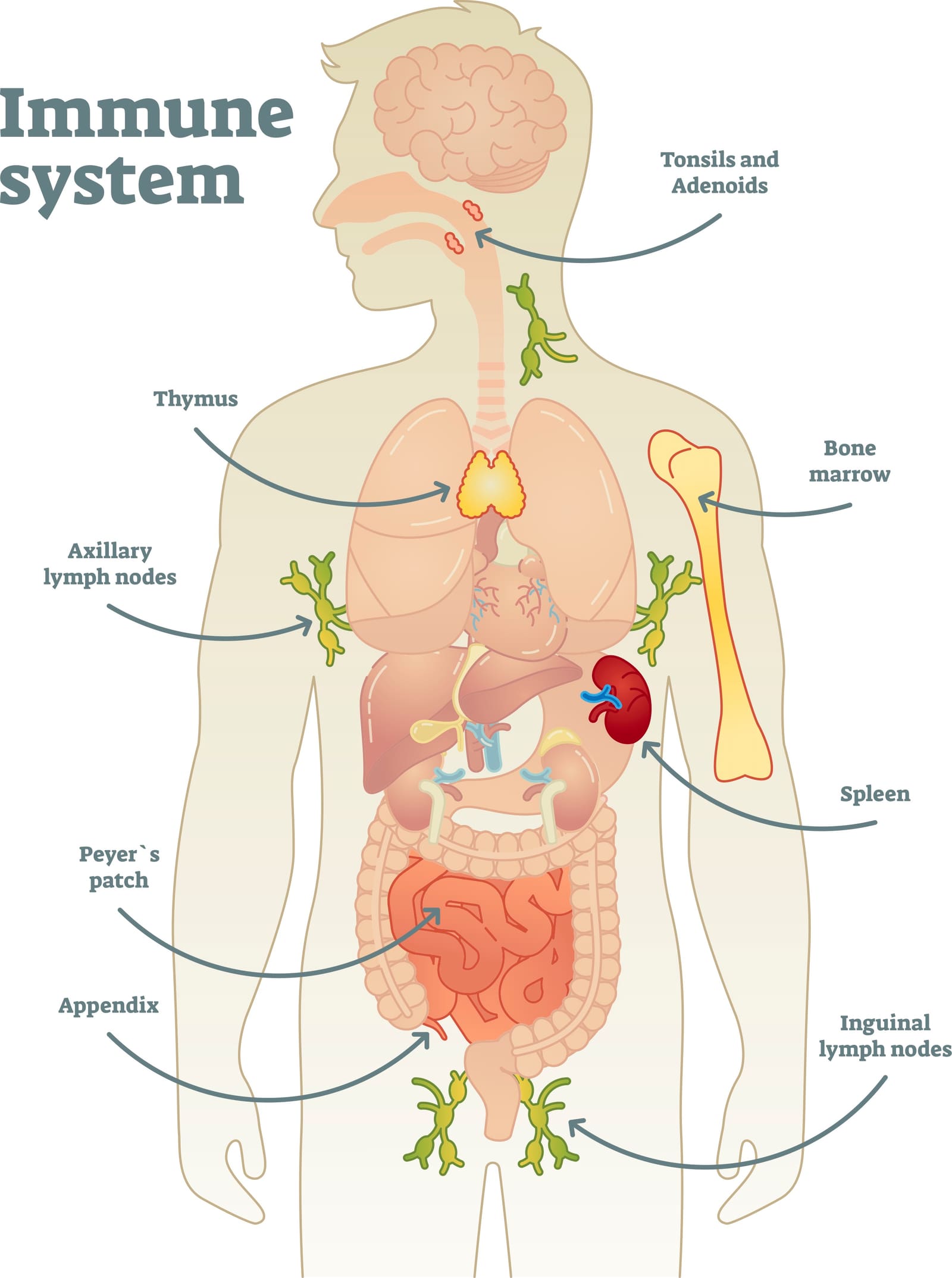
Introduction to the Immune System
The immune system is the body’s powerful system of defense against cancer, microorganisms (bacteria, fungi, parasites, and viruses), and other foreign materials. In order to do protect the body without harming it, the immune system must recognize "self" (normal parts of our body) from "non-self" (cancer cells or invaders). This is accomplished by training the immune system from birth throughout life. The immune system is incredibly sophisticated and complex, but it can be generally categorized into 2 systems.
- Innate system: This is the first line of defense. It consists of white blood cells (e.g., macrophages, natural killer cells, neutrophils) that immediately prevent the spread of dangerous microorganisms or cancer cells in the body, primarily by ingesting and breaking down the invaders. They also have chemical messengers (cytokines) that alert the adaptive immune system and recruit them to the affected part of the body. Proteins called “complement” kill invaders directly and make it easier for other innate cells to ingest them. The innate immune response is nonspecific, which means that it will attack anything recognized as foreign, even if that cell has not been encountered before. The primary method of recognizing nonself is by recognizing molecular patterns that do not occur in the human body.
- Adaptive system: This is the second line of defense, and it is referred to as “specific immunity.” The main cells of the adaptive immune response are B cells and T cells. These cells respond to specific pathogens, or more accurately, pieces of them (antigens). Amazingly, human beings are equipped with enough B and T cells to respond to virtually any “nonself” antigen it encounters. When the innate immune system alerts the adaptive immune system, the B and T cells spring into action and begin multiplying. B cells generate antibodies that can neutralize the invaders and tag them for destruction by the innate immune system. T cells can either assist B cells in their multiplication and antibody production, or they may directly kill the foreign or infected cell. It can take several days or weeks for adaptive immune responses to fully kick into action the first time a new antigen is encountered. A hallmark of the adaptive immune response is memory. This mean that after your immune system has seen an antigen once, it will remember it and respond much quicker the next time (i.e., you are immune).
There are many more complexities than covered above; so, if you want to learn more about the immune system, the American Association of Immunologists lists many resources, and this is a great place to get started.
The Aging Immune System
As an individual ages, the immune system undergoes several normal changes. At birth, babies do not yet have a developed adaptive immune system. Their primary defense against infection is through innate immunity and protective maternal antibodies that crossed the placenta or breast milk. As children grow, their bone marrow produces B cells, and their thymus produces T cells. During development of these adaptive immune cells, a sophisticated tissue structure ensures that each B and T cell is trained to recognize self from non-self. If a developing B or T cell recognizes a self antigen, it will be signaled to die. If it does not recognize self, it will live and enter the circulation, ready to respond throughout the body if needed. The are virtually endless combinations of genes that B and T cells can rearrange during development to create receptors capable of reconigizing the vast majority of foreign invaders that a person could encounter during thier lifetime. The majority of these cells are created by the time a person reaches adulthood, at which point the production of new cells decreases.
For a healthy immune response, the innate and adaptive immune system must work together. A notable decrease in immune function occurs in the elderly. This is attributed to the following:
- Macrophages ingest foreign substances more slowly, giving invaders more time to grow unchecked.
- B and T cells respond to antigens more slowly.
- Fewer new white blood cells, including memory B and T cells, are generated.
- Antibodies are decreased quality, so they are not as effective at neutralizing foreign invaders and tagging them for destruction by the innate immune system.
- There are decreased levels of complement protein production, reducing the quality of the initial innate immune response.
- There is a decreased ability to heal wounds, in which the immune system plays an important role.
- There is a decreased ability for B and T cells to distinguish self antigens from nonself antigens.
These changes not only make people more vulnerable to infections and cancer, but they can also increase susceptibility to autoimmune diseases, such as lupus, rheumatoid arthritis, Type 1 (childhood onset) diabetes, and multiple sclerosis. In addition, decreased immune function makes it more difficult for vaccines to produce a desired level of immunity.
The reason for these changes are largely unknown, but the primary suspects are changes in underlying support tissues of the immune system and environmental damage that accumulates overtime (e.g., DNA damage).
What Can be Done to Support the Aging Immune System?
Like all aspects of aging, increasing general health from an early age – and maintaining it - can go a long way to slowing age-related declines in the immune response. Research into natural and pharmacologic interventions is ongoing. Preliminary evidence suggests there may be some immune-boosting benefits to caloric restriction, which is reducing calorie intake without decreasing nutrient intake; however, the overall risks and benefits with this practice are not well understood. Drugs that increase the number and function of innate immune cells are being investigated in laboratory studies and clinical trials. So far, there is no miracle drug that can fully restore the immune response, but preliminary data suggest that future medicines may become available to boost immunity in elderly people. There are some concerns with developing these medicines, because increasing the production or activity of any cell in the body could lead to cancer or autoimmunity if it is too strong or lasts for too long. More work is needed in the quest to reverse or slow age-related immune system changes.
According to the the Merk Manual, there are currently 2 ways people can safely support their aging immune system:
- Increase healthy lifestyle choices, including exercise, healthy eating, stopping smoking, and limiting alcohol intake.
- One easy action people can take to enhance their immunity is to take booster vaccinations. Over time, there is a decrease in immunity that was gained in younger years from naturally fighting an infection or receiving a vaccine. Special versions of vaccines are available for people over age 50 to 65 years that will protect them from some common vaccine-preventable illnesses. These include pneumococcal pneumonia, shingles, and influenza.
Sources
Información general, no consejo médico
Este artículo no puede tener en cuenta tu historial de salud ni tu tratamiento actual. Habla con un profesional sanitario cualificado antes de cambiar nada de tu cuidado.
Lee nuestro aviso médico →
En esta página
Introduction to the Immune System
The Aging Immune System
What Can be Done to Support the Aging Immune System?
Sources
Pon en práctica lo que lees
Controla tus medicamentos, consulta un síntoma y habla con personas que viven con la misma enfermedad, todo en Healthread.
Descargar la app
Sigue leyendo
Beauty and Anti-Aging
Gastric Balloon for Weight Loss
The gastric balloon weight loss procedure is a new FDA-approved minimally invasive bariatric procedure for treating obesity. It is a temporary procedure that involves placing a saline-filled silicone balloon in the…
19 de junio de 2025 · 3 min de lectura
Beauty and Anti-Aging
Vitamin D Deficiency
Also known as the sunshine vitamin, vitamin D is an essential nutrient that is naturally absorbed by the skin through exposure to sunlight. It can also be obtained from dietary sources and supplements.
30 de diciembre de 2024 · 3 min de lectura
Beauty and Anti-Aging
Cellulite
Cellulite appears with an orange peel or cottage cheese-like texture with a dimpled or lumpy skin surface. Mild cellulite is visible when you pinch the area with cellulite, like the thighs. Severe cellulite can make the…
13 de agosto de 2024 · 3 min de lectura


© 2026 Healthread
English · Español
Healthread no ofrece asesoramiento médico, diagnóstico ni tratamiento. Consulta siempre a un profesional sanitario cualificado sobre tu atención.