

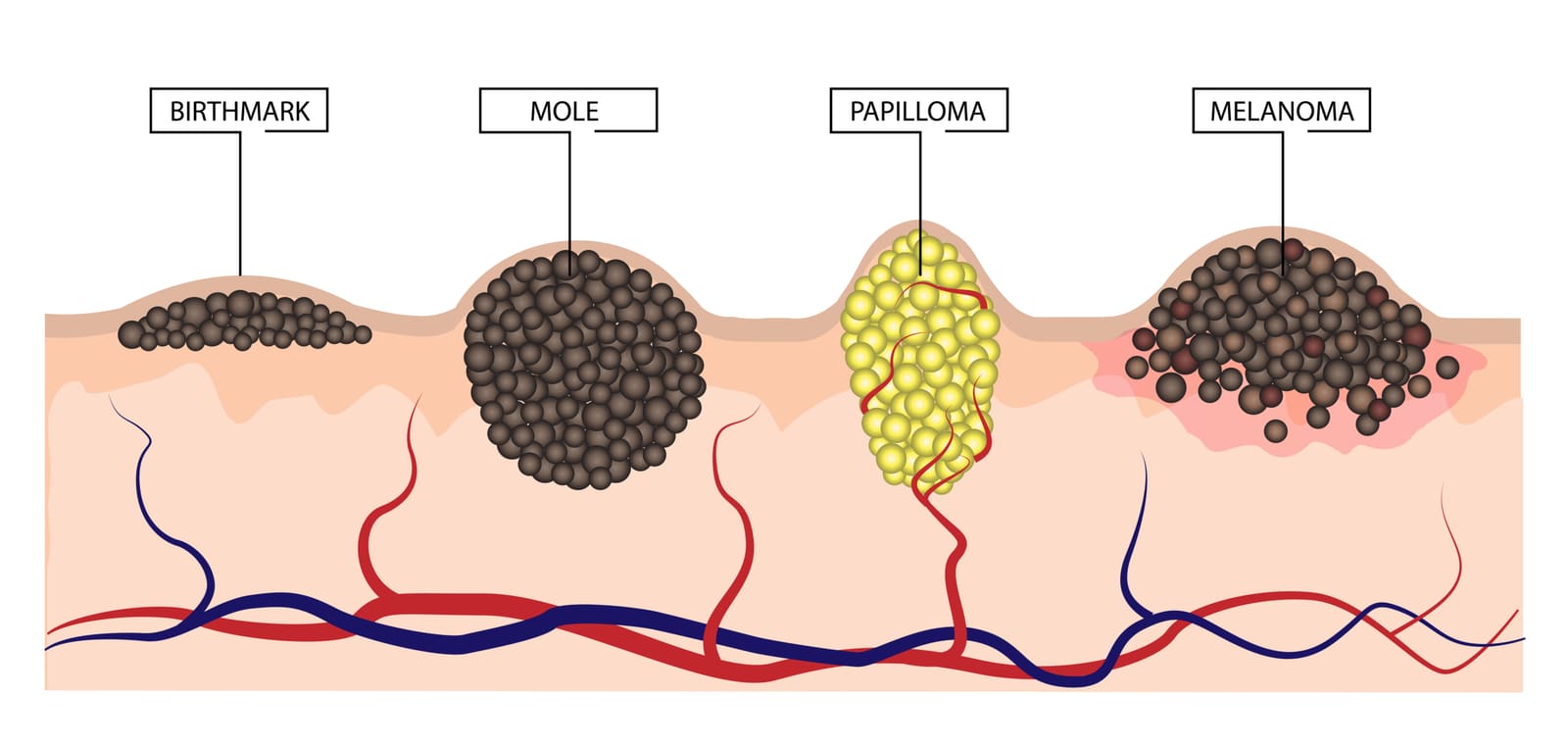
Melanoma is the most aggressive type of skin cancer and the type with the highest mortality rate. What makes melanoma so deadly? If not detected and treated early, it metastasizes, or spreads, quickly to other organs. Once that happens, the chances of a cure drop significantly.
Each year, approximately 75,000 people in the U.S. are diagnosed with melanoma. Roughly 10,000 people succumb to the disease. Men are at a slightly higher risk than women.
Avoiding excessive sun exposure and always wearing sunscreen with a Sun Protection Factor (SPF) of at least 30 are the best ways to protect yourself against melanoma. The sun’s ultraviolet rays are still harmful in winter and on cloudy days, so prevention is a 365-day a year venture.
Melanoma
Cells that produce pigment are called melanocytes. When melanocyte reproduction becomes out of control, melanoma results.
It is not possible to predict just how fast a melanoma will spread, but it can happen very fast.
Spotting Melanoma Early
The survival rates for melanomas discovered prior to spreading, or in situ, are far higher than those detected after metastasis occurs. That is why conducting a monthly skin check is crucial. See a doctor immediately if you notice any potential signs of melanoma. These for any changes in moles, based on the A, B, C, D, and E model:
- A–Asymmetry. The halves of the mole are uneven.
- B–Border irregularities
- C–Color of the skin varies within the same mole. Melanomas may include shades of brown, black, or tan, and some have red, gray, or white areas.
- D–Diameter. A diameter above 6 millimeters, the size of a pencil eraser, may indicate melanoma.
- E–Evolving. Is the mole new or have there been recent changes in its appearance?
A bleeding mole or one with a crust-like surface is potentially a melanoma.
Schedule an annual appointment with your dermatologist to have a whole-body skin check. If there are precancerous moles or lesions, the doctor can biopsy them. A pathologist will examine the sample to determine whether it contains cancer.
Where Melanoma Spreads
Like many cancers, melanoma usually spreads first into lymph nodes near the tumor site. From there, melanoma cells pass into the bloodstream and the rest of the body. A recent study in mice funded by the National Cancer Institute found that melanoma cells passing through the lymphatic system prior to entering the bloodstream spread more easily and form new tumors more rapidly than melanoma cells entering the bloodstream directly.
Beyond the lymph nodes, melanoma most commonly spreads to the:
- Lungs
- Liver
- Subcutaneous tissue
- Brain
- Gastrointestinal tract
- Bones
- Adrenal glands
Melanoma Prognosis
Patients diagnosed with melanoma want to know their prognosis. Prognosis and survival depend on various factors. These include:
- Tumor thickness –A thicker tumor has a poorer prognosis. If the melanoma is less than 1 mm thick it is less likely to spread to other areas of the body. Those tumors above 4 mm in thickness are more likely to metastasize. These growths are also more prone to recurrence, or coming back after removal.
- Location –Melanomas on the limbs have a better prognosis than those found on the trunk, neck, or head. Melanomas may also appear on the soles of the feet or palms of the hand. These melanomas generally have a poorer prognosis.
- Cancer in lymph nodes –The higher the number of lymph nodes containing cancer, the poorer the prognosis. If the nodes are enlarged enough for palpation during diagnostic imaging tests, that indicates a worse prognosis than if there are only micrometastases, or tiny amounts of cancer, in the nodes.
- Ulceration –An ulcerated melanoma, one with an open wound, has a less favorable prognosis than a tumor that does not ulcerate. Ulceration raises the risk of metastasis.
- Mitotic rate –This is the measure of the speed of cancer cell division and growth. Mitosis is the number of cells dividing in a particular amount of cancer tissue. A high mitotic rate is associated with a poorer prognosis.
- Growth pattern –A type of skin cancer known as nodular melanoma has a poor prognosis because it grows vertically into the skin. It is usually a thicker tumor.
When the melanoma has spread to distant organs, the prognosis is not good.
Survival Rates
Keep in mind that survival rates for melanoma are estimates. Much depends on the cancer’s stage, consisting of tumor size and whether it has spread. When caught early, before it has a chance to spread, the five-year survival rate for Stage 1A melanoma is 97 percent.
Survival rates are based on the percentage of patients diagnosed with melanoma who are alive X years after diagnosis. It does not necessarily mean all of those individuals died from melanoma.
For Stage 2A, the five-year survival rate is 81 percent. For stage 3A, it is 78 percent, and 59 percent for stage 3B. For stage 4, the highest stage, the rate drops to between 15 and 20 percent.
Sources
Información general, no consejo médico
Este artículo no puede tener en cuenta tu historial de salud ni tu tratamiento actual. Habla con un profesional sanitario cualificado antes de cambiar nada de tu cuidado.
Lee nuestro aviso médico →
En esta página
Melanoma
Spotting Melanoma Early
Where Melanoma Spreads
Melanoma Prognosis
Survival Rates
Sources
Pon en práctica lo que lees
Controla tus medicamentos, consulta un síntoma y habla con personas que viven con la misma enfermedad, todo en Healthread.
Descargar la app
Sigue leyendo

Cancer-Updates
Gynecologic Cancer
Gynecologic cancer is a term used to describe a group of cancers that affect the female reproductive system. There are five types of gynecologic cancers named after the body part where they start.
5 de noviembre de 2024 · 3 min de lectura

Cancer-Updates
Anal Cancer
Anal cancer is caused when the cancer cells in the anus grow uncontrollably, forming masses or tumors. The cancer cells can sometimes spread to other body parts, causing metastatic cancer.
18 de agosto de 2024 · 3 min de lectura

Cancer-Updates
Bile Duct Cancer (Cholangiocarcinoma)
Bile duct cancer, or cholangiocarcinoma, is a cancer that occurs in the bile ducts, the slender tubes that collect bile, a fluid made by the liver for breaking down fats in the digestion process.
17 de abril de 2024 · 2 min de lectura


© 2026 Healthread
English · Español
Healthread no ofrece asesoramiento médico, diagnóstico ni tratamiento. Consulta siempre a un profesional sanitario cualificado sobre tu atención.