

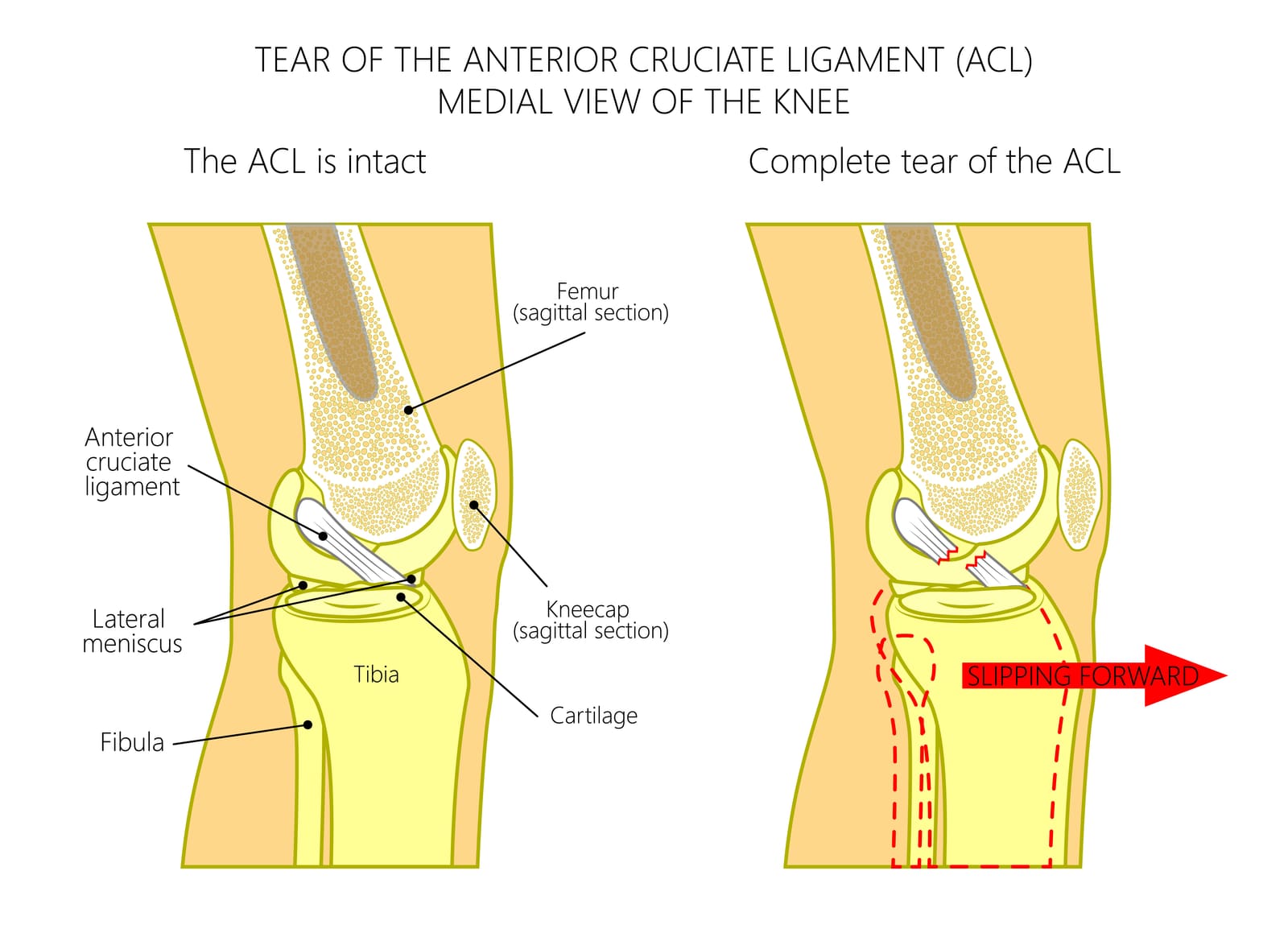
The anterior cruciate ligament is a key component in stabilizing the knee and is frequently damaged by those who participate in contact sports or experience trauma. Studies show 1 in 3500 people have an ACL injury. An anterior cruciate ligament is one of the most common injuries seen involving the ligaments. When an ACL is injured, many people experience damage to surrounding ligaments, the meniscus, and the articular cartilage.
Types of an ACL tear
ACL injuries are not all the same. Some may experience a partial tear that does not require extensive treatment, while others experience a complete tear that requires more invasive treatment.
- A partial ACL tear occurs when the ligament is slightly torn without seriously compromising the stability of the knee. People with a partial ACL tear have a better chance of full recovery than those with a more severe injury.
- A complete ACL tear leaves a person unable to bear weight. You may experience a “popping” sound from the knee at the time of the injury along with severe swelling and pain soon after.
How is an ACL injury graded?
An injured anterior cruciate ligament is graded on three levels:
- Grade 1: the ligament is only mildly damaged. It may be slightly stretched but the knee remains stable.
- Grade 2: the ligament stretches, becoming loose. A person may have slight instability.
- Grade 3: the ligament is completely torn or pulled away from the bone completely.
How is an anterior cruciate ligament injury treated?
Depending on the severity, an ACL injury can be treated non-surgically or surgically.
Non-surgical treatment
A partial or grade one ACL injury is often treated through non-invasive techniques like rehabilitation and consistent physical therapy. With consistent treatment, patients can see improved mobility and joint stability, while some may even reach pre-injury conditions as if the injury did not occur. For many, a hinged knee brace is ordered to be worn to aid in stability.
Surgical treatment
Surgery for correcting an ACL tear is often referred to as anterior cruciate ligament reconstruction. Rather than repairing the ligament with stitches, which have failed several times, the ligament is replaced by donor or grafted ligaments.
How do you know if you need surgery?
The decision to undergo surgical intervention to treat an ACL tear will depend on the severity of the tear you have. Your doctor will conduct a series of tests to grade the tear, evaluate your personal medical history, and thoroughly explain their findings to you. Tests include imaging, a physical examination, and two key tests:
- The Lachman test: a doctor will strategically pull the shin bone away from the thigh bone. If the ACL is intact, the bones are not easily moved.
- The pivot shift test: a doctor will have you lie on your back while lifting the leg and placing rotational pressure. If the bones shift, the test is scored as positive, requiring further investigation.
How soon after your injury should you receive ACL surgery?
Even in severe cases, surgery is not performed immediately. After an ACL injury, profound swelling and inflammation are present, making surgery risky. Most physicians allow up to six weeks for inflammation to subside to reduce the risk of developing arthrofibrosis or profound scarring.
How does anterior cruciate ligament surgery work?
During surgery for an ACL tear, the surgeon will carefully remove the torn or damaged ligament to be replaced by an autograft (from the patient) or allograft (from a donor) ligament. The primary areas where a ligament is grafted include the patella, quadriceps, hamstring, and Achilles tendon.
Surgery is conducted using an arthroscopic approach through a small incision with fiber optics and small instruments. This reconstructive surgery is performed as an outpatient procedure, meaning a hospital stay is not required when no complications arise.
Takeaway
An anterior cruciate ligament injury can be a serious condition that affects a person’s daily living. In the U.S., more than 100,000 ACL reconstructive surgeries are performed each year, allowing each patient the chance at a normal life with few limitations.
General information, not medical advice
This article can't account for your health history or current treatment. Talk to a qualified clinician before you change anything about your care.
Read our medical disclaimer →
On this page
Types of an ACL tear
How is an ACL injury graded?
How is an anterior cruciate ligament injury treated?
Non-surgical treatment
Surgical treatment
How do you know if you need surgery?
How soon after your injury should you receive ACL surgery?
How does anterior cruciate ligament surgery work?
Takeaway
Put what you read to work
Track your medicines, check a symptom and talk with people managing the same condition, all in Healthread.
Get the app
Keep reading

Beauty and Anti-Aging
Gastric Balloon for Weight Loss
The gastric balloon weight loss procedure is a new FDA-approved minimally invasive bariatric procedure for treating obesity. It is a temporary procedure that involves placing a saline-filled silicone balloon in the…
June 19, 2025 · 3 min read

Beauty and Anti-Aging
Vitamin D Deficiency
Also known as the sunshine vitamin, vitamin D is an essential nutrient that is naturally absorbed by the skin through exposure to sunlight. It can also be obtained from dietary sources and supplements.
December 30, 2024 · 3 min read

Cancer-Updates
Gynecologic Cancer
Gynecologic cancer is a term used to describe a group of cancers that affect the female reproductive system. There are five types of gynecologic cancers named after the body part where they start.
November 5, 2024 · 3 min read


© 2026 Healthread
English · Español
Healthread does not provide medical advice, diagnosis or treatment. Always speak to a qualified clinician about your care.