

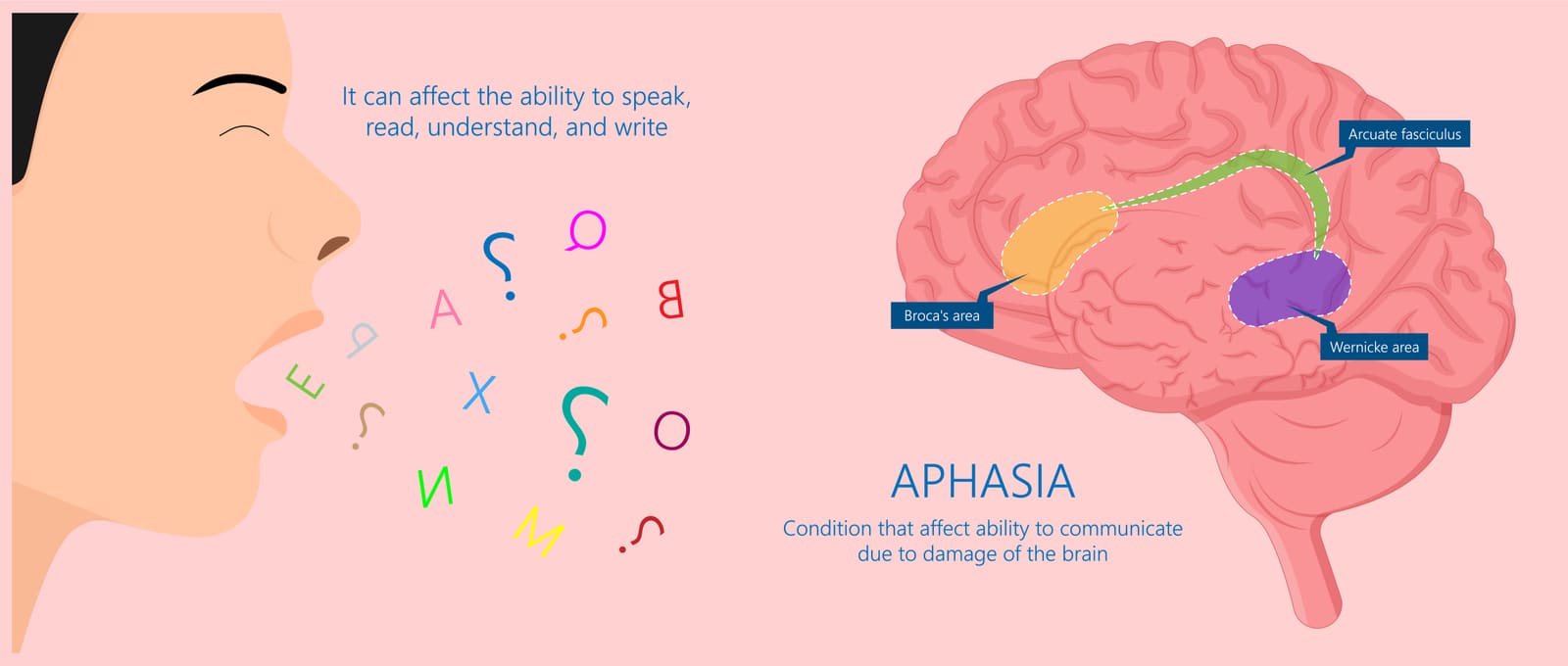
Aphasia is a health problem that robs you of your ability to communicate. It develops as the result of damage to the parts of the brain responsible for processing language. Aphasia usually develops suddenly after a head injury or stroke, but it can come on slowly as the result of a slow-growing brain tumor or progressive brain disease that worsens over time. Treatment can help, but recovering language skills usually takes time.
The condition is quite common. In fact, more people have aphasia than cerebral palsy, multiple sclerosis, Parkinson’s disease, or muscular dystrophy, according to the National Aphasia Association. About 2 million people in the United States have aphasia. Approximately one-third of strokes results in aphasia.
Types of Aphasia
There are two main types of aphasia, fluent and non-fluent, and several subgroups within these two main types.
Wernicke’s aphasia
Also known as fluent aphasia, Wernicke’s aphasia interferes with someone’s ability to grasp the meaning of spoken words and sentences, but it does not affect their ability to speak. In other words, someone with Wernicke’s aphasia produces words and sentences, but what they say may not make a lot of sense; reading and writing are severely impaired.
Broca’s aphasia
Also known as non-fluent aphasia, Broca’s aphasia results in stilted speech in which someone has to work hard to force a couple of words out. People with Broca’s aphasia typically rely on important keywords, such as a verb and one or two nouns, to convey their thoughts.
Aphasia Affects Specific Parts of the Brain
Aphasia develops as the result of injury to specific parts of the brain. As its name suggests, Broca’s aphasia affects Broca’s area, a part of the brain associated with a person’s ability to produce speech and articulate their thoughts. Broca’s area is located in the left hemisphere of the brain.
Similarly, Wernicke’s aphasia develops as the result of injury to Wernicke’s area, a part of the brain involved with a person’s ability to comprehend written or spoken language. Wernicke’s area is located in the area of the brain near the ear.
Another part of the brain, known as the angular gyrus, helps process language, number processing and spatial cognition, memory retrieval, and attention. The angular gyrus sits in close proximity to other critical brain regions, such as the temporal lobe that processes sound, the occipital lobe that analyzes visual information, and the parietal lobe that processes information from our sense of touch. It allows us to associated language-related information from what we hear, see, and touch.
Aphasia Treatments
If aphasia is mild, the person may recover their language skills without any treatment. Most people with aphasia benefit from speech and language therapy to help rehabilitate their language skills and improve their communication experiences. Researchers are currently looking into the use of medications, either alone or in combination with speech therapy, to help those with aphasia.
Speech and language therapy is a relatively slow process. Most people make significant progress in improving their speech and communication, but few ever regain the ability to communicate as well as they had prior to their injury or illness. Therapy focuses on restoring language, teaching people how to make up for their language deficits, and finding other means of communication.
For best results, therapy should start soon after the brain injury. Many people find it helpful to work in groups, where they can try communicating in a safe environment by practicing conversations, speaking in turn, clarifying miscommunications, and repairing conversations that have broken down completely. In some cases, the use of a computer can help the person re-learn verbs and word sounds.
Researchers are investigating the use of medications to treat aphasia. These medications may improve blood flow to the brain, enhance the brain’s ability to recover, or even help replace chemicals that pass messages in the brain. More research is needed before doctors can recommend these treatments.
For more information about aphasia, consult with a doctor or speech therapist.
Sources
General information, not medical advice
This article can't account for your health history or current treatment. Talk to a qualified clinician before you change anything about your care.
Read our medical disclaimer →
On this page
Types of Aphasia
Wernicke’s aphasia
Broca’s aphasia
Aphasia Affects Specific Parts of the Brain
Aphasia Treatments
Sources
Put what you read to work
Track your medicines, check a symptom and talk with people managing the same condition, all in Healthread.
Get the app
Keep reading

Beauty and Anti-Aging
Gastric Balloon for Weight Loss
The gastric balloon weight loss procedure is a new FDA-approved minimally invasive bariatric procedure for treating obesity. It is a temporary procedure that involves placing a saline-filled silicone balloon in the…
June 19, 2025 · 3 min read

Beauty and Anti-Aging
Vitamin D Deficiency
Also known as the sunshine vitamin, vitamin D is an essential nutrient that is naturally absorbed by the skin through exposure to sunlight. It can also be obtained from dietary sources and supplements.
December 30, 2024 · 3 min read

Cancer-Updates
Gynecologic Cancer
Gynecologic cancer is a term used to describe a group of cancers that affect the female reproductive system. There are five types of gynecologic cancers named after the body part where they start.
November 5, 2024 · 3 min read


© 2026 Healthread
English · Español
Healthread does not provide medical advice, diagnosis or treatment. Always speak to a qualified clinician about your care.