

Here's an eye-opening exercise:
Look at a clock. Watch until 40 seconds goes by. Whenever that short amount of time goes by, someone in America has a stroke. If you were to keep watching the clock until four minutes goes by, someone in the U.S. will die of complications of a stroke. In total, about 795,000 Americans experience a stroke every year.
These statistics aren't meant to be gratuitously grim. Instead, agencies like the Centers for Disease Control and Prevention (CDC) simply want people to be aware of how serious and common strokes are. A stroke—sometimes called a "brain attack"—happens when the cells and tissues in a part of your brain begin to die. In most cases (about 87% of the time), this happens because a part of the brain becomes starved of blood and oxygen due to a block in blood flow.
Some strokes are mild and may not cause permanent brain damage or long-lasting symptoms. But some strokes can be life-changing, chronically disabling, or even deadly. Doctors know that the sooner someone receives medical treatment after experiencing a stroke, the better chances they have of recovering and staying alive. That's why being able to recognize the early warning signs are so important.
Do you know the key stroke warning signs? It's something you and all your loved ones should know—and there's even a simple acronym that can help you remember.
BE FAST to save a Life: Top Warning Signs of Stroke
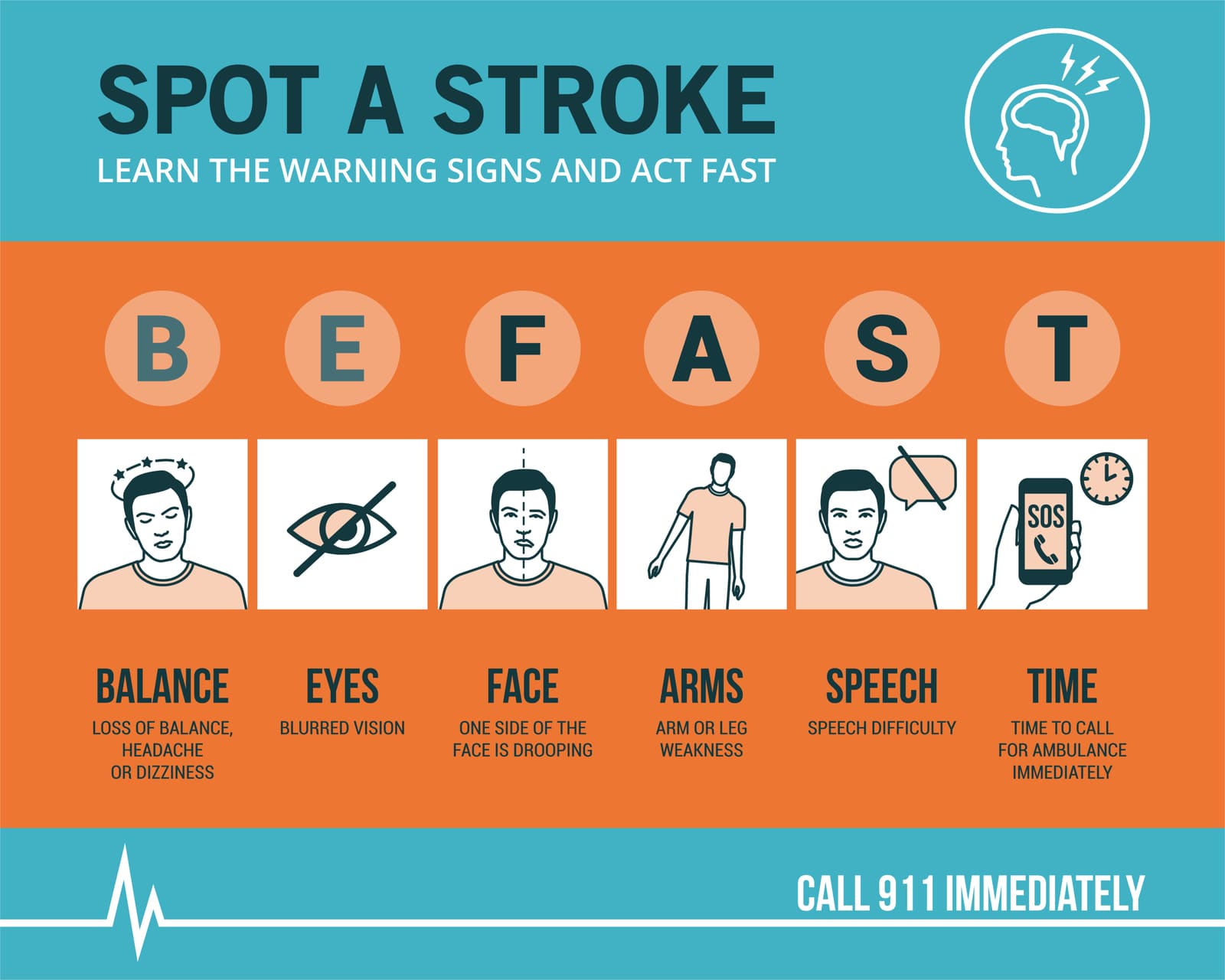
If you believe you or a loved one is experiencing a stroke, then BE FAST and seek emergency medical care right away. BE FAST refers to the sudden onset of symptoms you may notice:
- B = balance (sudden imbalance, clumsiness, or incoordination)
- E = eyes (sudden vision changes, often accompanied by a severe headache)
- F = face (sudden drooping on one side of the face—for example, a person may not be able to smile symmetrically)
- A = arm or leg (sudden weakness or numbness in an arm or leg; you may start dropping things out of your hand or tripping over your foot)
- S = speech (sudden difficulty speaking or understanding other people—for example, a person may not be able to repeat back a simple sentence like "The sky is blue")
- T = time (get to an emergency room or call 911 right away)
These warning signs and symptoms can sometimes occur up to hours or days before a major stroke, according to 2005 research published by the American Academy of Neurology, in what doctors call "mini-strokes" or transient ischemic attacks (TIAs). The symptoms of a TIA generally last fewer than five minutes. But even if symptoms go away completely you should still seek medical attention, since this could help you avoid a bigger stroke in the future.
In fact, nearly a quarter of all the people who experience stroke every year will eventually have a second stroke, according to Johns Hopkins Medicine. Proper medical treatment and healthy lifestyle changes (such as smoking cessation, exercise, stress management, and improvements in diet) can help stroke survivors reduce their chances of going through the experience again.
The Bottom Line on Stroke Warning Signs
- Strokes, whether large or small, happen frequently—at least once every 40 seconds in America
- Strokes usually come with sudden warning signs and symptoms, which you can remember using the acronym BE FAST
- Many stroke survivors are at risk of having another stroke in the future—so seeking early and immediate medical care is important for protecting their long-term health
Have you or a loved one ever experienced a TIA or stroke? What were your warning symptoms? Share them with our Healthread readers in the comments and be sure to subscribe for more up-to-date information on stroke prevention and treatment.
Sources
General information, not medical advice
This article can't account for your health history or current treatment. Talk to a qualified clinician before you change anything about your care.
Read our medical disclaimer →
On this page
BE FAST to save a Life: Top Warning Signs of Stroke
The Bottom Line on Stroke Warning Signs
Sources
Put what you read to work
Track your medicines, check a symptom and talk with people managing the same condition, all in Healthread.
Get the app
Keep reading
Beauty and Anti-Aging
Gastric Balloon for Weight Loss
The gastric balloon weight loss procedure is a new FDA-approved minimally invasive bariatric procedure for treating obesity. It is a temporary procedure that involves placing a saline-filled silicone balloon in the…
June 19, 2025 · 3 min read
Beauty and Anti-Aging
Vitamin D Deficiency
Also known as the sunshine vitamin, vitamin D is an essential nutrient that is naturally absorbed by the skin through exposure to sunlight. It can also be obtained from dietary sources and supplements.
December 30, 2024 · 3 min read

Cancer-Updates
Gynecologic Cancer
Gynecologic cancer is a term used to describe a group of cancers that affect the female reproductive system. There are five types of gynecologic cancers named after the body part where they start.
November 5, 2024 · 3 min read


© 2026 Healthread
English · Español
Healthread does not provide medical advice, diagnosis or treatment. Always speak to a qualified clinician about your care.