

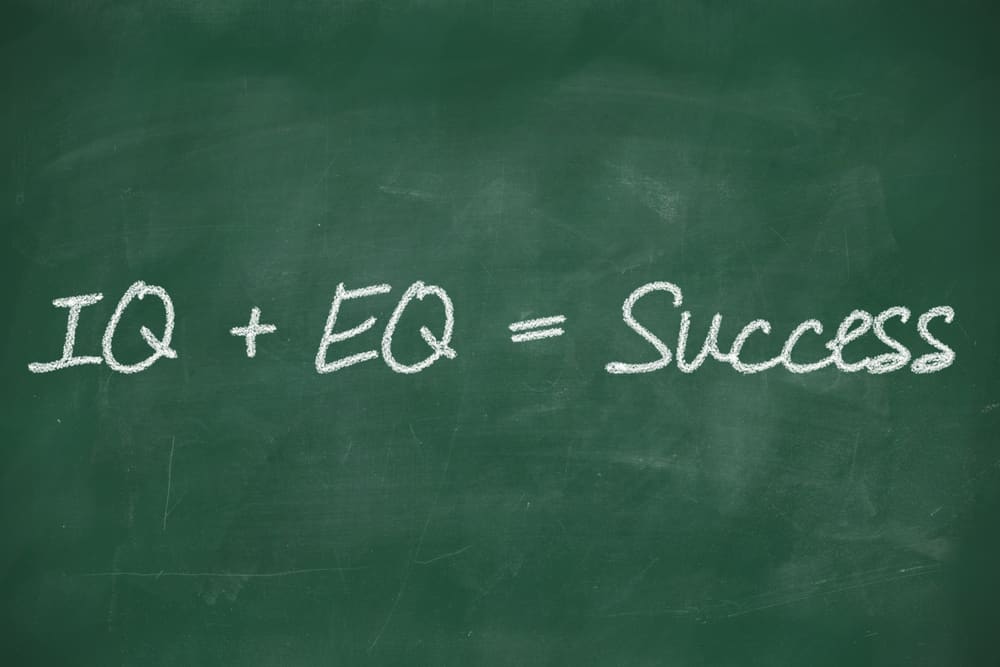
Do you know your IQ? How about your EQ?
While most of us have heard of the term Intelligence Quotient or IQ (a standard way of measuring someone's reasoning skills and intelligence), few of us have ever explored the term Emotional Quotient (EQ), more commonly known as emotional intelligence. The term was initially described in 1990 by psychologists John Mayer and Peter Salovey, and became popularized in 1996 by author Dan Goleman in his book Emotional Intelligence.
What is emotional intelligence, and why does it matter? Let's take a look at this important human characteristic and discuss how you can develop it in yourself.
What is Emotional Intelligence?
Psychology Today defines emotional intelligence as "the ability to identify and manage one’s own emotions, as well as the emotions of others." This includes a few core skills or attributes, including:
- Self awareness: the ability to identify and name your own emotions
- Social awareness: the ability to identify and name other people's emotions, feel empathy, pick up on emotional cues, and recognize interpersonal dynamics within a group or organization
- Self-management: the ability to control your feelings and behaviors, avoid impulsivity, adapt, be disciplined, problem solve, and regulate your emotions in a healthy way
- Relationship management: the ability to develop good relationships, influence others, work well with others, manage conflict, and communicate
With these skills, the emotionally intelligent person may be more likely to remain self-assured and self-confident in challenging situations—from tight deadlines to bouncing back from failure. This can help them succeed virtually all areas of life, including relationships, school or work, sports, physical health, mental health, and personal goals.
Unlike an IQ test, there's no standard test or way to measure emotional intelligence. This can make emotional intelligence difficult to define and research scientifically. For example, Psychology Today notes that the evidence linking emotional intelligence and career success is inconclusive. And a 2019 systematic review published in Frontiers in Psychology yielded mixed results on the "stress-buffering effects" of emotional intelligence.
But at least intuitively, it makes sense that being more attuned with one's own emotions (and the emotions of others) can improve your stress levels, health, and quality of life. The question, how can you achieve this?
3 Ways to Strengthen Your Emotional Intelligence
According to Harvard Business Review, research shows emotional intelligence is strongly influenced by early childhood experiences and even our genes—but that doesn't mean it's fixed. Here are three things you can try that may boost your emotional intelligence:
- 1.Explore cognitive behavioral therapy. Professional support from a mental health provider can you specific tools, training, and feedback you need to hone your emotional intelligence skills.
- 2.Learn about (and practice) nonverbal communication, active listening, and other techniques that can help you better relate to others.
- 3.Consider investing in books, seminars, and games geared toward building emotional intelligence—for a variety of resources, try Six Seconds, the Emotional Intelligence Network.
Interested in Boosting Your Emotional Intelligence?
Feeling like a success in life isn't just about being smart—it's also about learning how to identify, express, and manage your emotions well. Do you have any resources or techniques that have helped you develop your emotional intelligence? Share your insights on the Healthread app today!
Sources
- 1ihhp.com/meaning-of-emotional-intelligence/
- 2ihhp.com/meaning-of-emotional-intelligence/
- 36seconds.org/sei/media/WP_EQ_and_Age.pdf
- 4hbr.org/2013/05/can-you-really-improve-your-em
- 5frontiersin.org/articles/10.3389/fpsyg.2019.00810/full
- 6hbr.org/2013/05/can-you-really-improve-your-em
- 7helpguide.org/articles/mental-health/emotional-intelligence-eq.htm
- 8psychologytoday.com/us/basics/emotional-intelligence
General information, not medical advice
This article can't account for your health history or current treatment. Talk to a qualified clinician before you change anything about your care.
Read our medical disclaimer →
On this page
What is Emotional Intelligence?
3 Ways to Strengthen Your Emotional Intelligence
Interested in Boosting Your Emotional Intelligence?
Sources
Put what you read to work
Track your medicines, check a symptom and talk with people managing the same condition, all in Healthread.
Get the app
Keep reading

Beauty and Anti-Aging
Gastric Balloon for Weight Loss
The gastric balloon weight loss procedure is a new FDA-approved minimally invasive bariatric procedure for treating obesity. It is a temporary procedure that involves placing a saline-filled silicone balloon in the…
June 19, 2025 · 3 min read
Beauty and Anti-Aging
Vitamin D Deficiency
Also known as the sunshine vitamin, vitamin D is an essential nutrient that is naturally absorbed by the skin through exposure to sunlight. It can also be obtained from dietary sources and supplements.
December 30, 2024 · 3 min read

Beauty and Anti-Aging
Cellulite
Cellulite appears with an orange peel or cottage cheese-like texture with a dimpled or lumpy skin surface. Mild cellulite is visible when you pinch the area with cellulite, like the thighs. Severe cellulite can make the…
August 13, 2024 · 3 min read


© 2026 Healthread
English · Español
Healthread does not provide medical advice, diagnosis or treatment. Always speak to a qualified clinician about your care.